
Introduction
1、Product advantages
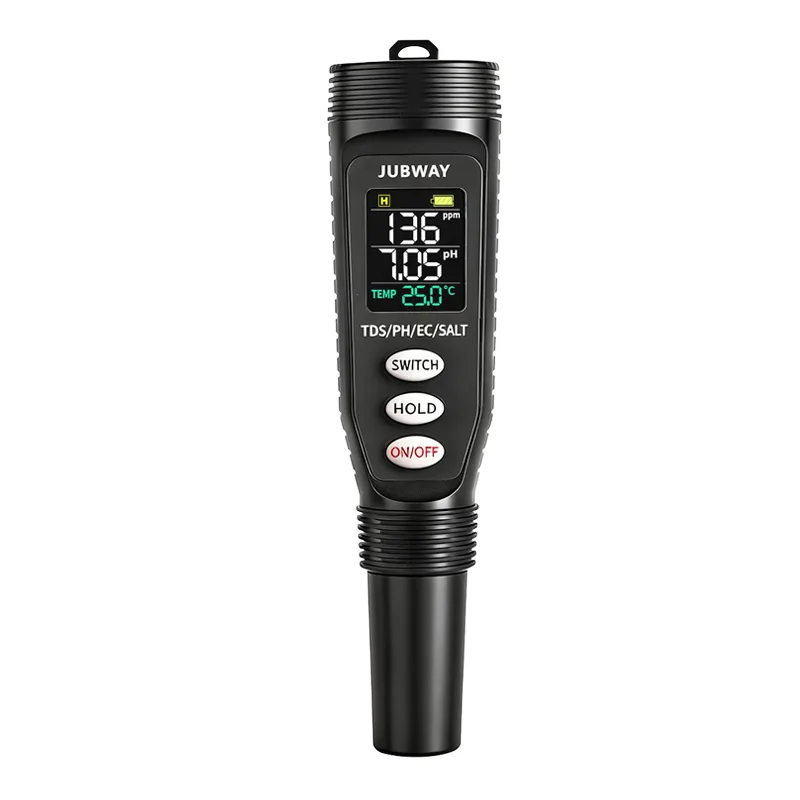
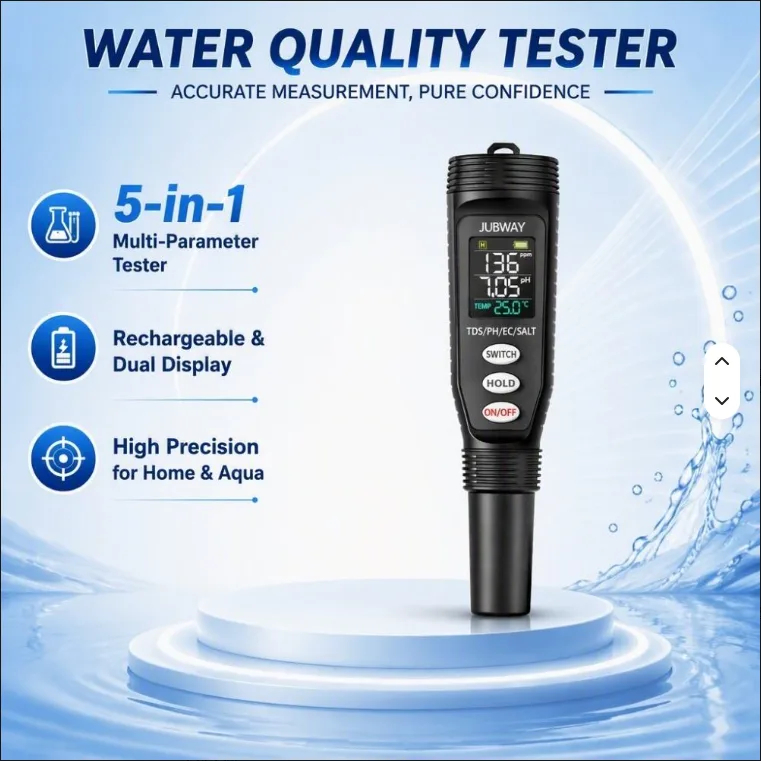
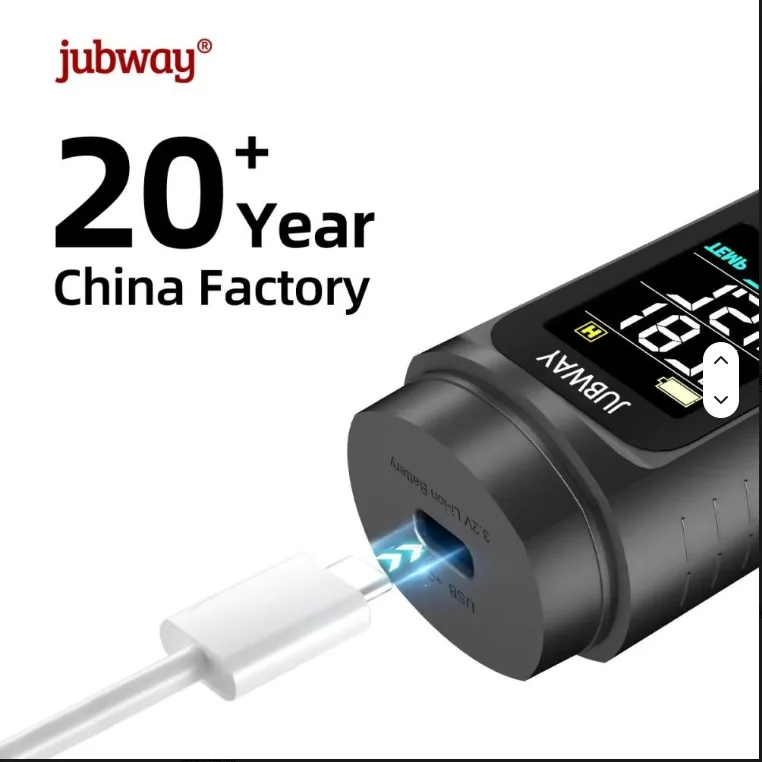
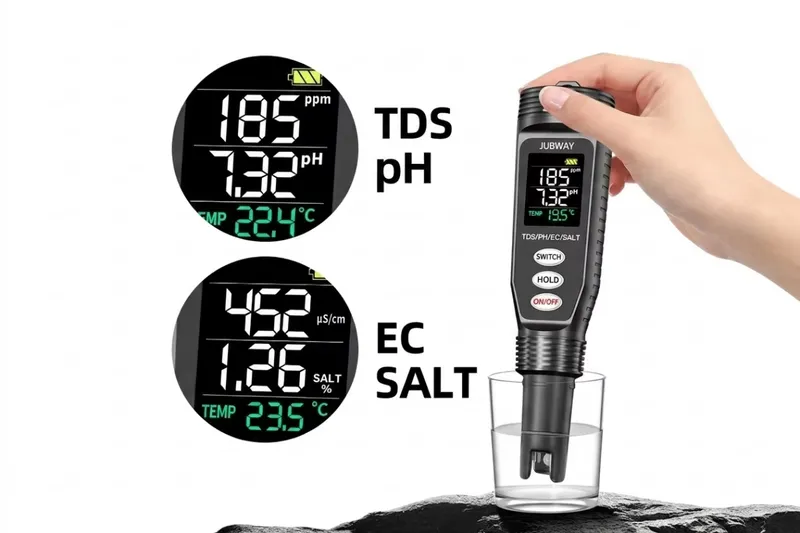
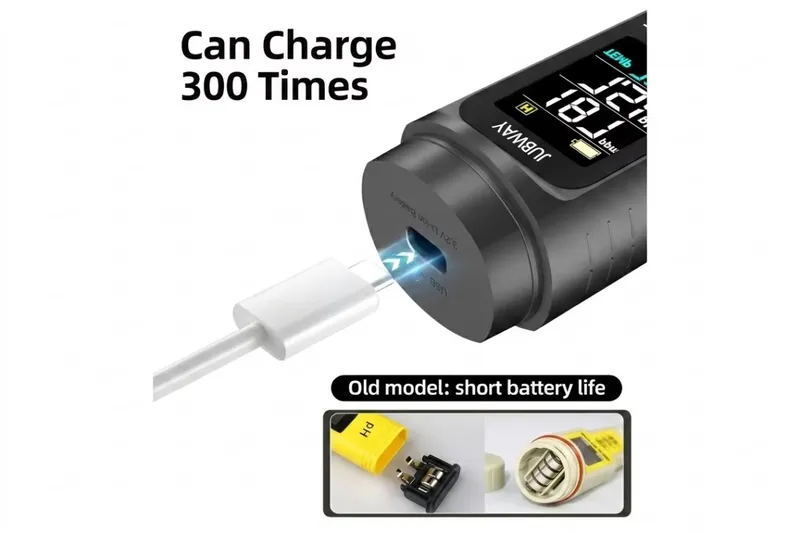
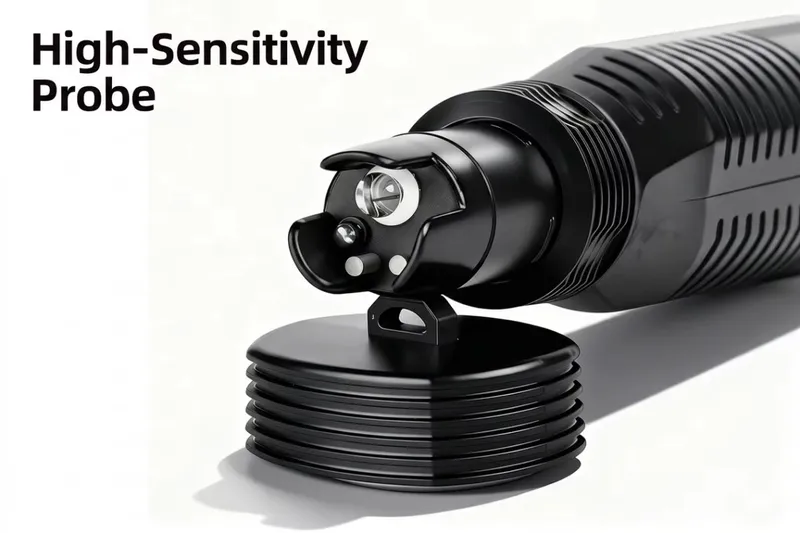
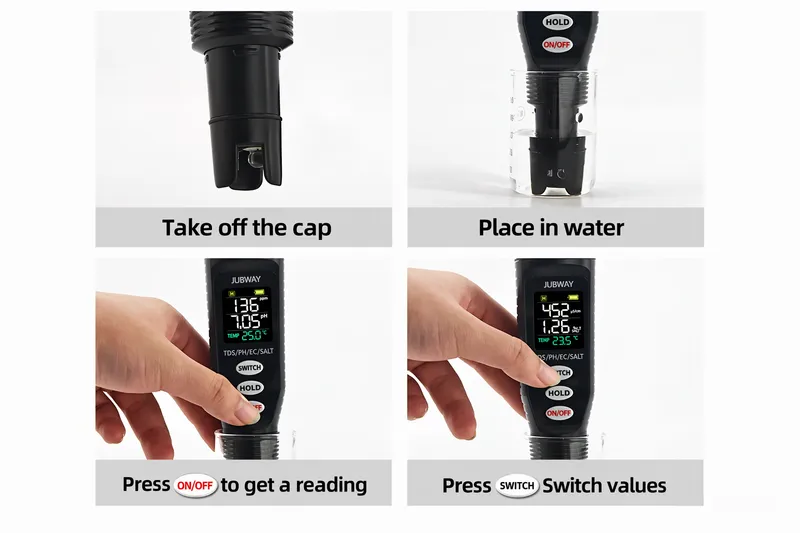
(1) 600mAh large-capacity rechargeable lithium battery, lasts up to six months on a single charge. (2) HD backlit display with clear readings visible even in low light. (3) High-performance titanium alloy probe for stable, accurate measurements across a wide range. (4) pH uses nano-salt bridge technology for stable readings and extended electrode life. (5) Type-C charging port compatible with standard Android cables. (6) Triple display on one screen: first screen shows TDS, pH, and Temp; second screen shows EC, SALT, and Temp.
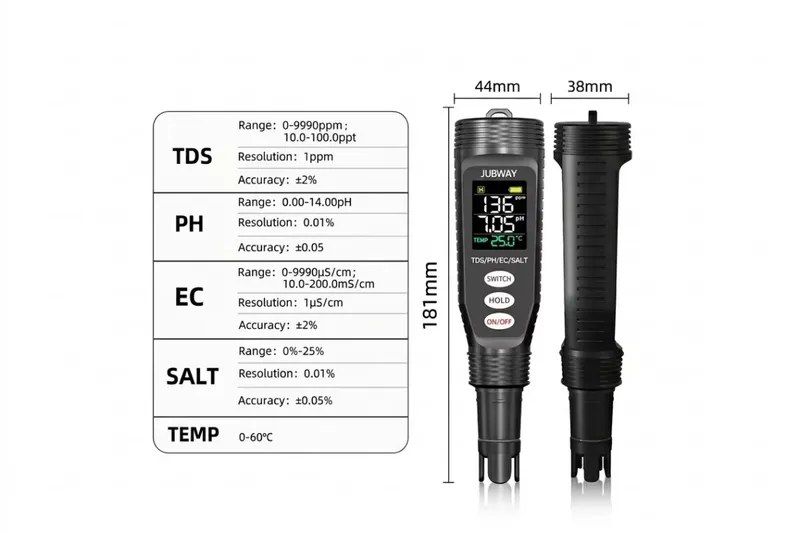
2、Specifications
(1) TDS: Range 0-9990ppm (10.1-100.0ppt), Resolution 1ppm/0.1ppt, Accuracy ±2% F.S. (2) pH: Range 0.00-14.00pH, Resolution 0.01pH, Accuracy ±0.05pH. (3) EC: Range 0-9990μS/cm (10.1-200.0mS/cm), Resolution 1μS/cm/0.1mS/cm, Accuracy ±2% F.S. (4) SALT: Range 0.01%-25.00%; Accuracy ±0.1% F.S for 0.01%-5.00%, ±1%~±2% F.S for 5.1%-25.00%. (5) Temp: Range 0-60°C (32.1-140.0°F), with ATC for automatic temperature compensation of parameters.
3、Applications
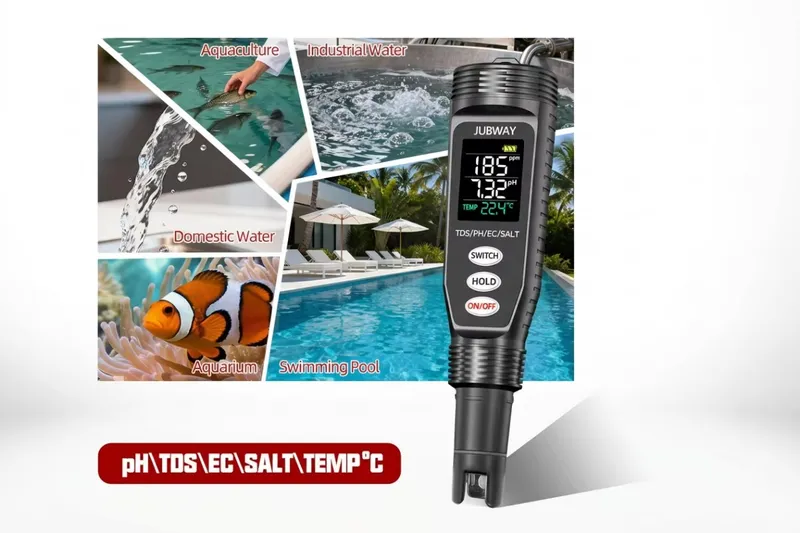
(1) Rapid testing of household drinking water and water purifier output. (2) Water quality monitoring and maintenance for aquariums and fish tanks. (3) Aquaculture water body management. (4) Testing nutrient solution concentration for hydroponic plants. (5) Water environment testing for swimming pools, hot springs, and similar settings.
4、How to use
5、Packaging & shipping

6、OEM customization
7、Company strengths

FAQ
Q: Does the C919 have a hold function?
A: Yes, this product features a hold function. Press the hold button once to lock the reading on the current screen, and press it again to unlock.
Q: How often does the pH function need to be calibrated?
A: Unlike most sand-core technologies on the market, the pH electrode of this product uses nano-salt bridge technology. After the initial calibration, it generally only needs to be recalibrated every 1-2 months.
Q: Does pH measurement require calibration?
A: Yes. pH detection is based on electrochemical principles. Long-term use causes the depletion of the reference solution, leading to reading deviations, so regular calibration is required.
Q: What should I do if the measurement exceeds the range?
A: The maximum ranges for TDS and EC are 100ppt and 200mS/cm respectively, covering extreme concentrations in most scenarios, so it is generally unlikely to exceed the range.
Q: What is the purpose of temperature measurement?
A: Water quality indicators (especially electrical conductivity) are highly affected by temperature. The temperature reading is used for the device's Automatic Temperature Compensation (ATC) to reduce measurement deviations caused by temperature.
Q: What is the most important precaution for using this product?
A: The testing pen must not be used to test highly corrosive strong acid or strong alkaline solutions, nor water above 70°C, as this will cause irreversible damage to the pH electrode. After testing high-salinity water samples, the probe must be rinsed with purified water to prevent clogging of the nano-salt bridge.
Q: What is TDS?
A: Total Dissolved Solids, representing the total amount of dissolved substances in water.
Q: What is pH?
A: A unit of acidity or alkalinity, ranging from 0.00 to 14.00; 7 is neutral, below 7 is acidic, and above 7 is alkaline.
Q: What is EC?
A: Electrical Conductivity, representing the ability of an aqueous solution to conduct electric current.
Q: What is SALT?
A: Salinity, representing the content of dissolved salts in water.
Q: What is ppm?
A: Parts per million; 1ppm is approximately equal to 1mg/L.
Q: What is ppt?
A: Parts per thousand; in this product, 1ppt = 1000ppm.
Q: What is μS/cm?
A: Micro-siemens per centimeter, a unit of electrical conductivity.
Q: What is mS/cm?
A: Milli-siemens per centimeter; 1mS/cm = 1000μS/cm.
Q: What is F.S?
A: Full Scale; ±2% F.S means the error is calculated as a percentage of the full scale.