
Introduction
1、Product advantages
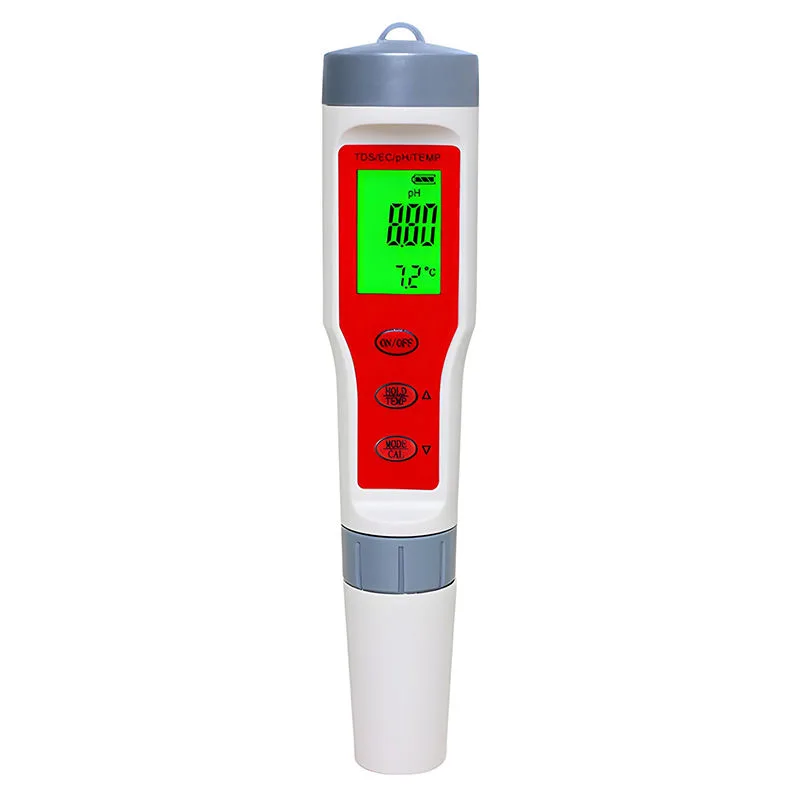
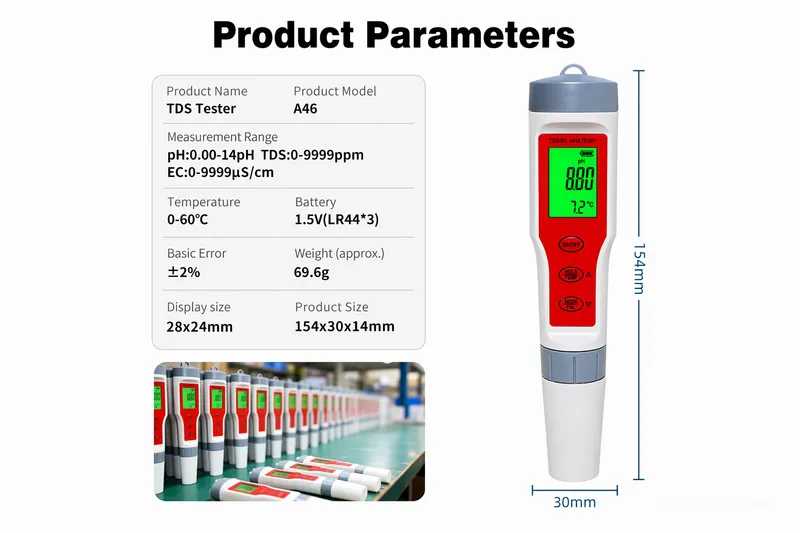
(1) Integrated pen-style design that combines TDS, pH, EC, and temperature testing. (2) Automatic temperature compensation that adjusts measurement results when temperature changes. (3) Automatically powers off after 5 minutes of inactivity to save battery. (4) Supports TDS/EC multi-point calibration and pH single, dual, or triple-point calibration. (5) Simple operation and clear readings, ideal for daily water self-testing and routine water monitoring. (6) Portable design with dimensions 188x37x37mm and a weight of approximately 90g, convenient for carrying.
2、Specifications
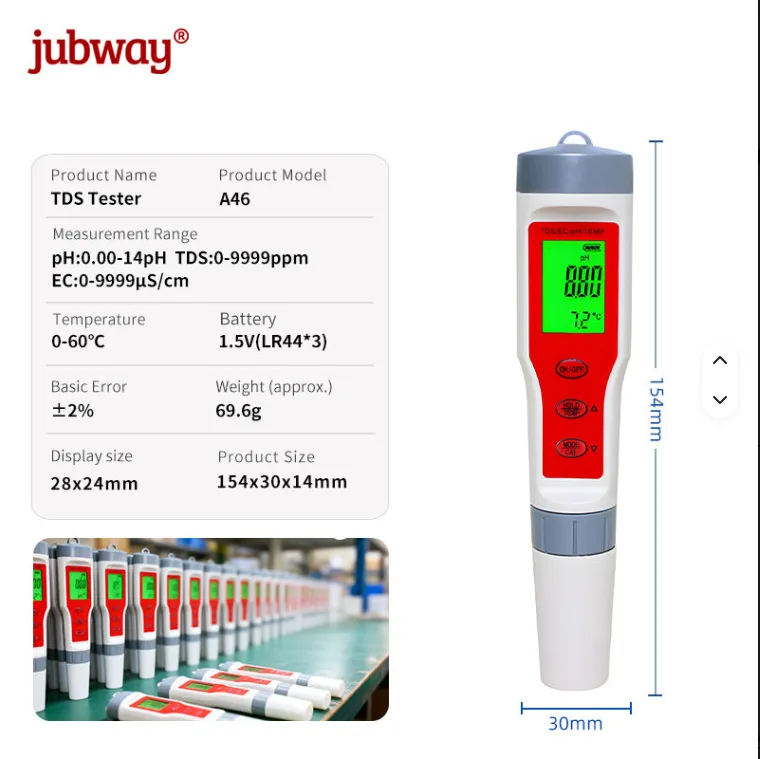
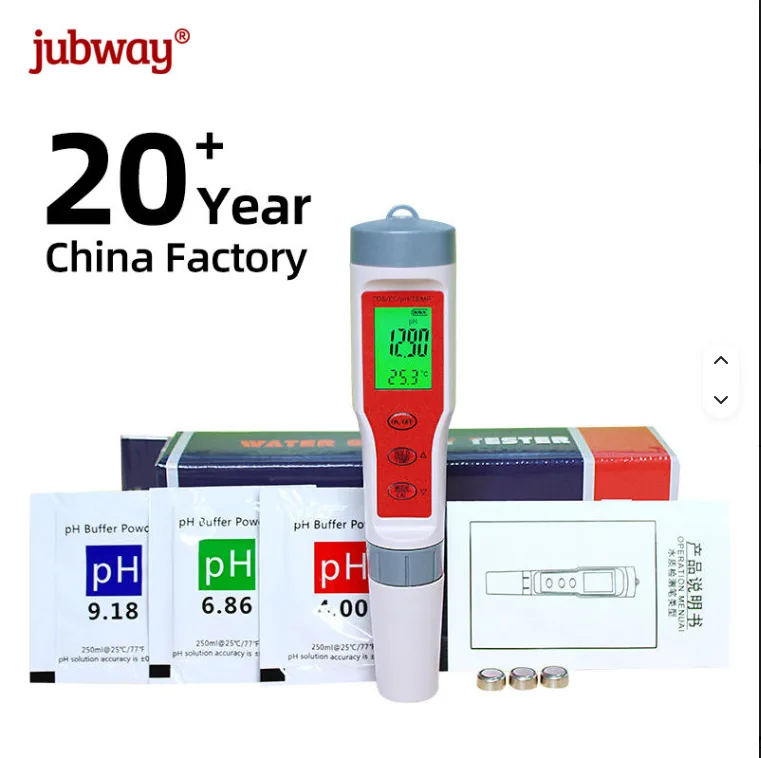
(1) TDS measurement: Range 1-19999 ppm, resolution 1 ppm, accuracy ±2%. (2) pH measurement: Range 0.00-14.00, resolution 0.01 pH; accuracy ±0.1 pH for 1-point calibration, ±0.05 pH for 2/3-point calibration. (3) EC measurement: Range 1-19999 μs/cm, resolution 1 μs/cm, accuracy ±2%. (4) Temperature measurement: Range 0-60°C (32-140°F), resolution 0.1°C/0.1°F, accuracy ±0.5°C. (5) Automatic temperature compensation: Supported. (6) Auto power-off: Automatically powers off after 5 minutes of inactivity. (7) Calibration solutions: TDS/EC uses 1413μs/cm standard solution; pH uses 6.86/4.00/9.18 standard solutions. (8) Battery: 3 LR44 button batteries, 1.5V each. (9) Dimensions and weight: 188x37x37mm, approximately 90g.
3、Applications
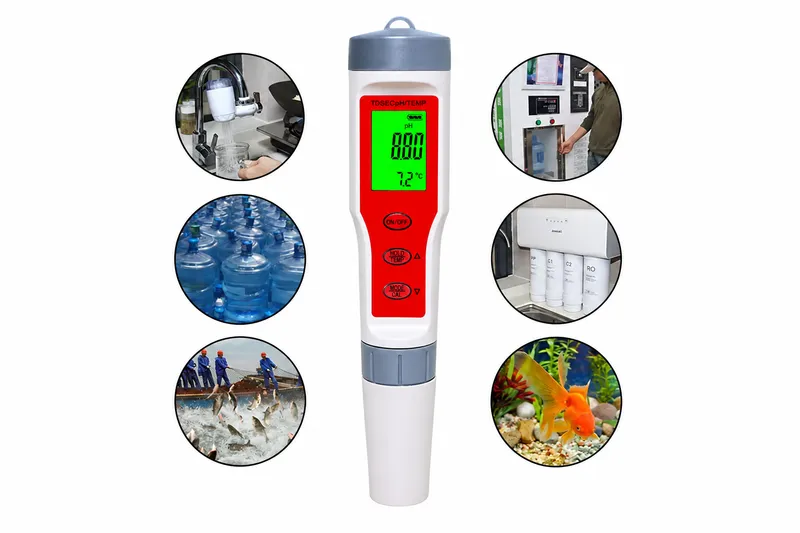
(1) Quick water quality testing for household drinking water, bottled water, and purified water from water purifiers. (2) Water quality monitoring for fish tanks and aquariums. (3) Nutrient solution concentration testing for hydroponic plants. (4) Routine water quality testing for swimming pools. (5) Laboratory, teaching demonstrations, and field water quality checks.
4、How to use
5、Packaging & shipping

6、OEM customization

7、Company strengths

FAQ
Q: What indicators can the A52 water quality testing pen measure?
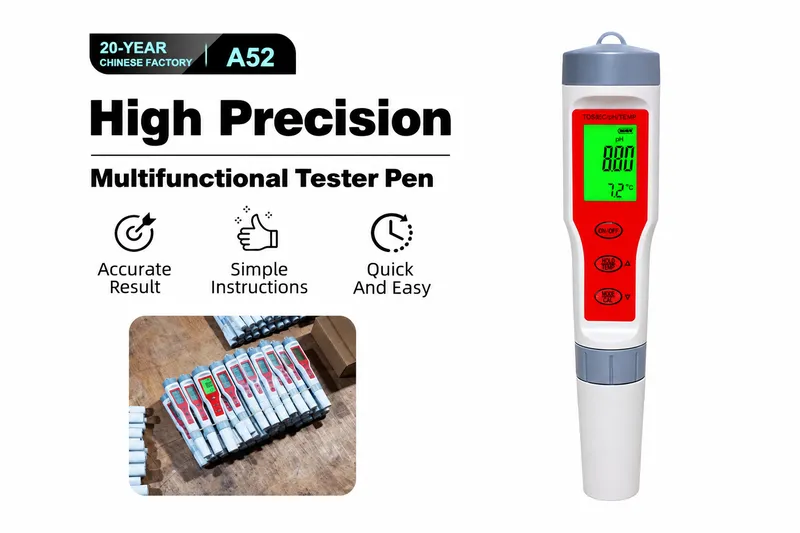
A: It can measure TDS (Total Dissolved Solids), pH (acidity/alkalinity), EC (Electrical Conductivity), and temperature.
Q: How to calibrate TDS/EC?
A: Calibrate using a 1413μs/cm standard solution.
Q: How to calibrate pH?
A: Perform 1-point, 2-point, or 3-point calibration using 6.86, 4.00, and 9.18 standard solutions.
Q: What is the difference between TDS and EC?
A: TDS represents the total amount of dissolved solids in water, measured in ppm; EC represents the electrical conductivity of water, measured in μs/cm. Both are used to reflect the ion content in water and usually have a corresponding relationship.
Q: How to replace the product battery?
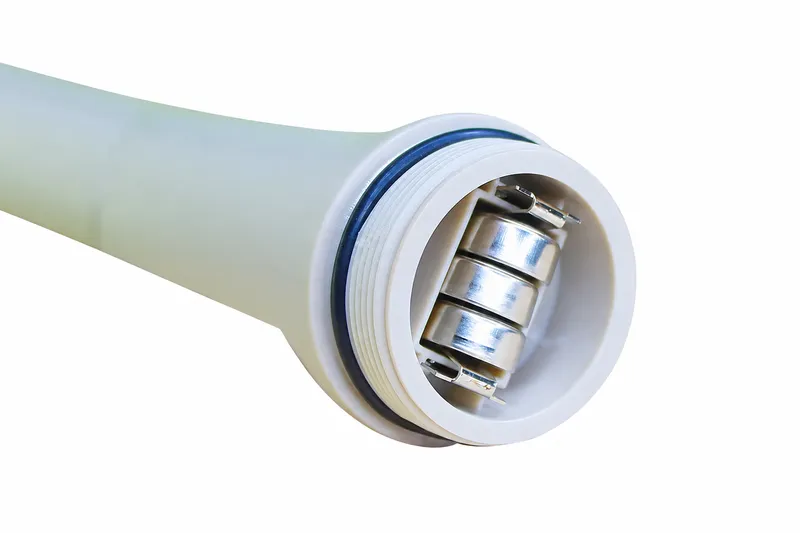
A: It uses 3 LR44 button batteries, 1.5V each. When the battery is low, open the battery compartment to replace them.
Q: Why does the testing pen shut down automatically?
A: The product automatically shuts down after 5 minutes of standby to save battery power. Simply turn it on again to continue using it.
Q: What is the temperature measurement range?
A: 0-60°C (32-140°F), supporting both Celsius and Fahrenheit displays.
Q: What is the measurement accuracy?
A: TDS is ±2%, EC is ±2%, and temperature error is ±0.5°C. The pH accuracy is ±0.1 pH for 1-point calibration, and ±0.05 pH for 2/3-point calibration.
Q: What is TDS?
A: Total Dissolved Solids, measured in ppm.
Q: What is pH?
A: Acidity/Alkalinity, representing the degree of acidity or alkalinity of an aqueous solution, ranging from 0.00 to 14.00.
Q: What is EC?
A: Electrical Conductivity, measured in μs/cm.
Q: What is TEMP?
A: Temperature, measured in °C or °F.
Q: What is ppm?
A: Parts per million, used to indicate TDS concentration.
Q: What is μs/cm?
A: Micro-siemens per centimeter, a unit of electrical conductivity.
Q: What is Automatic Temperature Compensation (ATC)?
A: A compensation mechanism that automatically adjusts measurement results based on water temperature changes.
Q: What is a standard solution?
A: A solution with a known concentration used for calibrating instruments.