
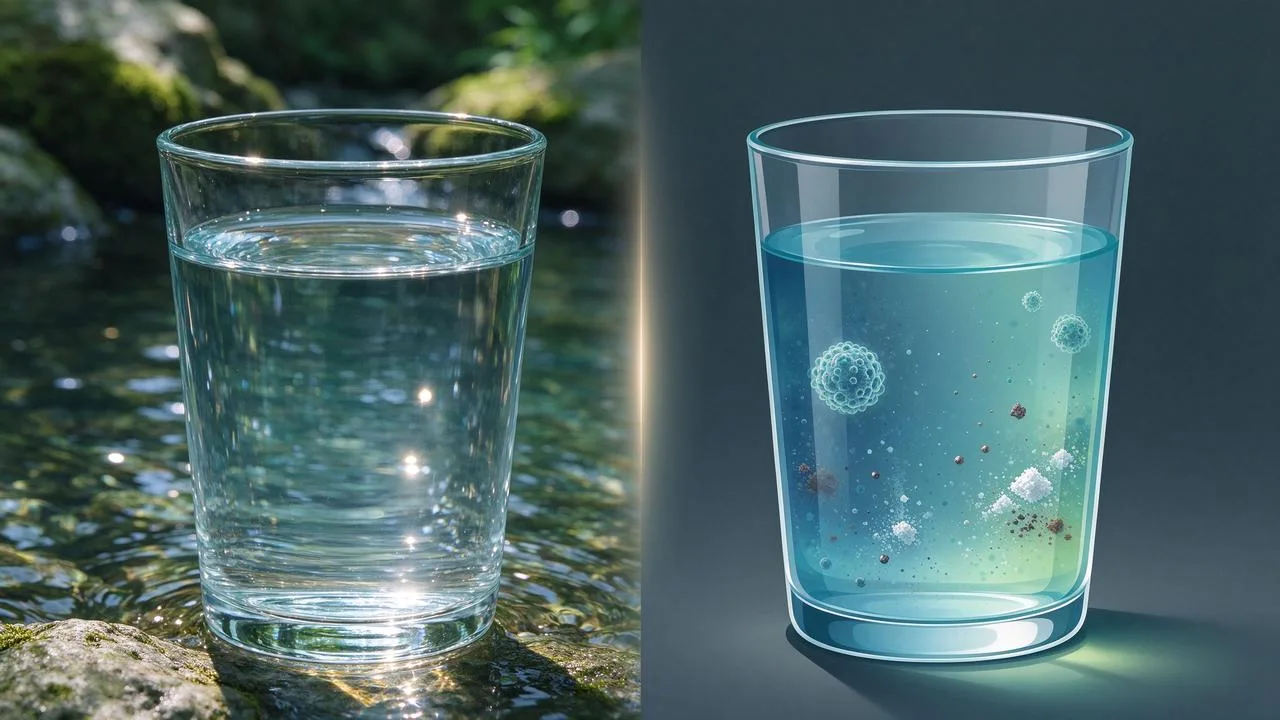
This article explains, from four dimensions—water quality standards, pollution sources, health risks, and household testing methods—why "clarity" cannot be used as a safety criterion for drinking water, and how families can scientifically assess and monitor their own well or spring water.
I. The Limitation of Visual Judgment: Drinking Water Standards Cover More Than "Turbidity"
The Standards for Drinking Water Quality (GB 5749-2022) were issued by the State Administration for Market Regulation and the Standardization Administration of China on March 15, 2022, and officially implemented on April 1, 2023. The standard specifies 97 water quality indicators across five categories: microbiological, toxicological, sensory and general chemical, disinfectant, and radiological.
What the human eye can observe is only one of these items—turbidity, i.e., the content of sediment, suspended solids, and colloidal matter. Most indicators that actually threaten health are completely invisible:
- Microbiological indicators: total coliforms, thermotolerant coliforms, E. coli, and total bacterial count—water remains crystal clear even when these are severely exceeded.
- Toxicological indicators: arsenic, cadmium, lead, mercury, chromium, as well as nitrate, fluoride, and cyanide—all dissolve invisibly and odorlessly.
- Chemical indicators: pH, total dissolved solids (TDS), total hardness, iron, and manganese—water with high mineral content may even taste "sweet," but that does not mean it is safe.
- Organic pollutants: pesticide residues, herbicides, and disinfection byproducts—at relevant concentrations, they cannot be detected by taste.
- A sampling survey of rural self-supplied drinking water found that among 20 well water samples, the pass rate for turbidity was only 35%, for total bacterial count 30%, and for total coliforms a mere 20%. This means a significant proportion of private wells are contaminated with fecal bacteria—completely undetectable by appearance.
II. The Core Difference Between Tap Water and Well Water: A Continuous Monitoring System
Tap water is safe not because it "looks cleaner," but because it operates within a continuous monitoring and treatment system from source to tap.
2.1 Centralized Water Supply: Treatment and Monitoring
- Source monitoring: source water is tested at least monthly for 29 basic and supplementary indicators per GB 3838.
- Water treatment: conventional processes include coagulation-sedimentation, sand filtration, activated carbon adsorption, and disinfection (chlorination or ozonation) to remove suspended solids, organics, and microorganisms.
- Treated water testing: nine routine indicators (turbidity, residual chlorine, total bacterial count, total coliforms, color, odor, etc.) are tested daily.
- Distribution network monitoring: residual chlorine is continuously tracked to maintain disinfection capacity throughout the pipeline.
2.2 Dispersed Water Sources (Wells and Springs): The Reality
Private wells and mountain springs generally lack the following safeguards:
- No routine testing: most private wells are tested once when drilled and never monitored again.
- No disinfection step: raw water is pumped directly for consumption with no sterilization.
- No source protection: wellheads are often open, uncovered, and vulnerable to rain, animals, debris, and surface runoff.
- No distribution protection: groundwater quality fluctuates with surrounding environmental changes.
- According to data from the Ministry of Ecology and Environment, during the 14th Five-Year Plan period, groundwater national monitoring points classified as Grade I–IV accounted for approximately 75%. This means roughly one in four groundwater monitoring points did not meet the standard for direct drinking. For private wells, which are shallower and less protected, the actual risk is typically higher than the regional average.
III. Three Common Sources of Groundwater Contamination
Figure 1: Schematic of groundwater contamination pathways—surface pollutants infiltrate through soil into the aquifer (illustration).
The Ministry of Ecology and Environment describes groundwater as having two defining characteristics: concealment (pollution is underground and cannot be visually detected) and complexity (spatial distribution depends on heterogeneous hydrogeological conditions). Understanding common contamination sources is the prerequisite for assessing your own well.
3.1 Nitrate Pollution: From Agriculture and Domestic Waste
Nitrate is one of the most widespread exceedance indicators in shallow rural groundwater.
The GB 5749-2022 limit for nitrate (as N) is 20 mg/L. Major sources include:
- Excessive nitrogen fertilizer (urea, compound fertilizers) on farmland; unused portions infiltrate with rainfall.
- Livestock and poultry manure leachate from farms.
- Septic tank leakage, domestic sewage, and landfill leachate.
- Wastewater irrigation and atmospheric deposition.
- Nitrate itself has low acute toxicity, but in infant gastrointestinal tracts it is reduced to nitrite, which oxidizes hemoglobin into methemoglobin, destroying its oxygen-carrying capacity. This causes methemoglobinemia, commonly known as "blue baby syndrome." Data from the U.S. CDC and ATSDR show that infants under 6 months are most susceptible; when methemoglobin levels exceed 50% and treatment is delayed, coma and death can follow rapidly. Historically, North America and Europe recorded approximately 2,000 infant cases linked to nitrate-contaminated well water, with a mortality rate of roughly 7%–8%.
3.2 Microbiological Pollution: Septic Tanks and Fecal Leakage
Microbiological contamination is another major risk for private wells. Total coliforms and thermotolerant coliforms serve as fecal contamination indicators; their presence signals potential enteric pathogens such as Shigella, Salmonella, Salmonella typhi, and norovirus.
Typical pathways include:
- Failed septic tank sealing allows effluent to infiltrate shallow groundwater.
- The wellhead is too close (often less than 10 meters) to toilets, pigpens, or waste piles; a recommended sanitary setback is at least 30 meters.
- After heavy rain or spring snowmelt, surface runoff flushes pollutants back into the well.
- This type of contamination is distinctly seasonal and episodic: water may test normal for months, then after a heavy rainfall, an entire family develops acute diarrhea—this is a classic microbiological contamination event.
3.3 Natural Heavy Metal Pollution: Geogenic Background
Unlike the anthropogenic pollution above, exceedances of arsenic, fluoride, iron, and manganese often originate from the mineral composition of the geological strata themselves, unrelated to human activity.
- Arsenic: long-term consumption of arsenic-exceeding water is associated with elevated risks of skin, bladder, and lung cancer, as well as cardiovascular and neurological damage.
- Fluoride: small amounts (≤1.0 mg/L) help prevent tooth decay; excess causes dental fluorosis (stained, crumbling teeth) and skeletal fluorosis (joint pain, bone deformity).
- Iron and manganese: exceedances cause yellowish water, sediment, and metallic taste; mainly affecting sensory properties, though long-term high intake also adds metabolic burden.
- The defining feature of geogenic pollution is its extreme concealment: the water may look exceptionally clear and taste normal, and it can only be identified through laboratory testing. Certain geological regions in China (parts of North China, Northwest China, and Southwest China) are naturally high in arsenic or fluoride; residents in these areas especially need regular testing.
IV. Why "Sweet, Soft, Cold Water" Is Not a Safety Criterion
Many residents judge well water by taste, describing it as "sweet," "soft," or "cold." From a water quality perspective, none of these serve as safety indicators:
- "Sweet": usually indicates high total dissolved solids (TDS) or elevated mineral content—this could be nitrate, calcium, magnesium, or heavy metals. Sweet ≠ safe; it simply means more dissolved substances.
- "Soft": soft water only means low calcium and magnesium; it does not indicate the absence of nitrate, arsenic, fluoride, or other pollutants.
- "Cold": low groundwater temperature only slows bacterial reproduction; it does not kill bacteria. Boiling is the economical and effective sterilization method.
- In reality, the most dangerous water is often the clearest-looking glass. Visible contaminants like sediment, rust, and algae can at least be spotted; nitrate, arsenic, and coliforms are indistinguishable from pure water in appearance and taste.
V. Practical Guidance for Household Well and Spring Water Safety
Based on the above analysis, Guangzhou Jiabei Water Treatment Co., Ltd. recommends the following practices for households relying on private wells or mountain springs:
5.1 Do Not Drink Raw Water Directly
Boiling is the most economical and effective means of killing microorganisms. However, it must be made clear: boiling kills bacteria and viruses, but it does not remove nitrate, heavy metals, or most chemical contaminants. If the water has nitrate or heavy metal exceedance, boiling alone will not solve the problem.
5.2 Establish a Regular Testing Routine
We recommend testing your well or spring water at least once a year, focusing on the following indicators:
- Microbiological: total bacterial count, total coliforms (to assess fecal contamination).
- Nitrate nitrogen: to assess agricultural and domestic pollution.
- pH and TDS: for a quick overview of acidity and dissolved solids; can be monitored daily using a portable TDS meter and pH meter.
- Arsenic and fluoride: essential for households in naturally high-arsenic or high-fluoride regions.
- Turbidity, color, odor: routine sensory indicators.
- For rapid on-site screening, portable TDS meters, pH testers, water electrolysis testers, and multi-parameter water test kits are practical tools. For precise indicators such as arsenic, fluoride, nitrate nitrogen, and total coliforms, samples should be sent to the local CDC or a CMA-accredited third-party laboratory.
5.3 Protect the Wellhead
- The well cover should be sealed and never left open.
- Within 30 meters of the wellhead, there must be no septic tanks, toilets, livestock pens, waste piles, or fertilized farmland.
- After heavy rain, if the water turns cloudy or develops an odor, suspend use until testing confirms safety.
- The well platform should be raised above ground with drainage channels to prevent surface water backflow.
5.4 Do Not Be Superstitious About "Natural"
Descriptions such as "spring," "well water," or "all-natural" carry no safety guarantee in water quality science. There is no "exempt" natural water source. Truly safe drinking water relies on regular testing, scientific treatment, and continuous monitoring—not on appearance or taste.
VI. Conclusion
The era of judging water quality by eye has passed. A glass of the clearest well water may be hiding nitrate, coliforms, and heavy metals; while tap water, governed by 97 indicators and daily monitoring, may carry a chlorine taste and limescale, it spares you the cost and risk of becoming your own "water chemist."
For households relying on private water sources, the core advice comes down to three sentences: never drink raw water, test at least annually, and protect the wellhead properly. Only by following these three steps can "looks clean" be upgraded to "genuinely safe."
About Guangzhou jubway Water Treatment Co., Ltd.: We specialize in the R&D and manufacturing of water quality testing equipment and water treatment products. Our product line includes TDS meters, pH testers, water electrolysis testers, multi-parameter water test kits, and hydrogen-rich water pens, providing convenient water monitoring solutions for household, commercial, and industrial scenarios. For product details or professional water quality testing advice, please contact us through our official website.
References:
1. State Administration for Market Regulation & Standardization Administration of China. Standards for Drinking Water Quality (GB 5749-2022). Implemented April 1, 2023.
2. Chinese Center for Disease Control and Prevention (China CDC). Household Drinking Water Safety Guidance (Private Well and Spring Water Safety Notes). June 2025.
3. Ministry of Ecology and Environment of the People's Republic of China. Press conference on the 15th Five-Year Plan for Soil, Groundwater, and Agricultural-Rural Ecological Environmental Protection. July 2026.
4. U.S. Centers for Disease Control and Prevention (CDC). Is My Well Water Safe to Drink? 2019.
5. Agency for Toxic Substances and Disease Registry (ATSDR). Nitrate/Nitrite Toxicity: Health Effects. 2023.
6. China Science Communication (Kepu China). Rural Raw Drinking Water Risk Science. May 2025.
Note: The cover image and illustrations are AI-generated scientific illustrations and do not represent actual water quality test results. Actual water quality status shall be subject to laboratory test data.