
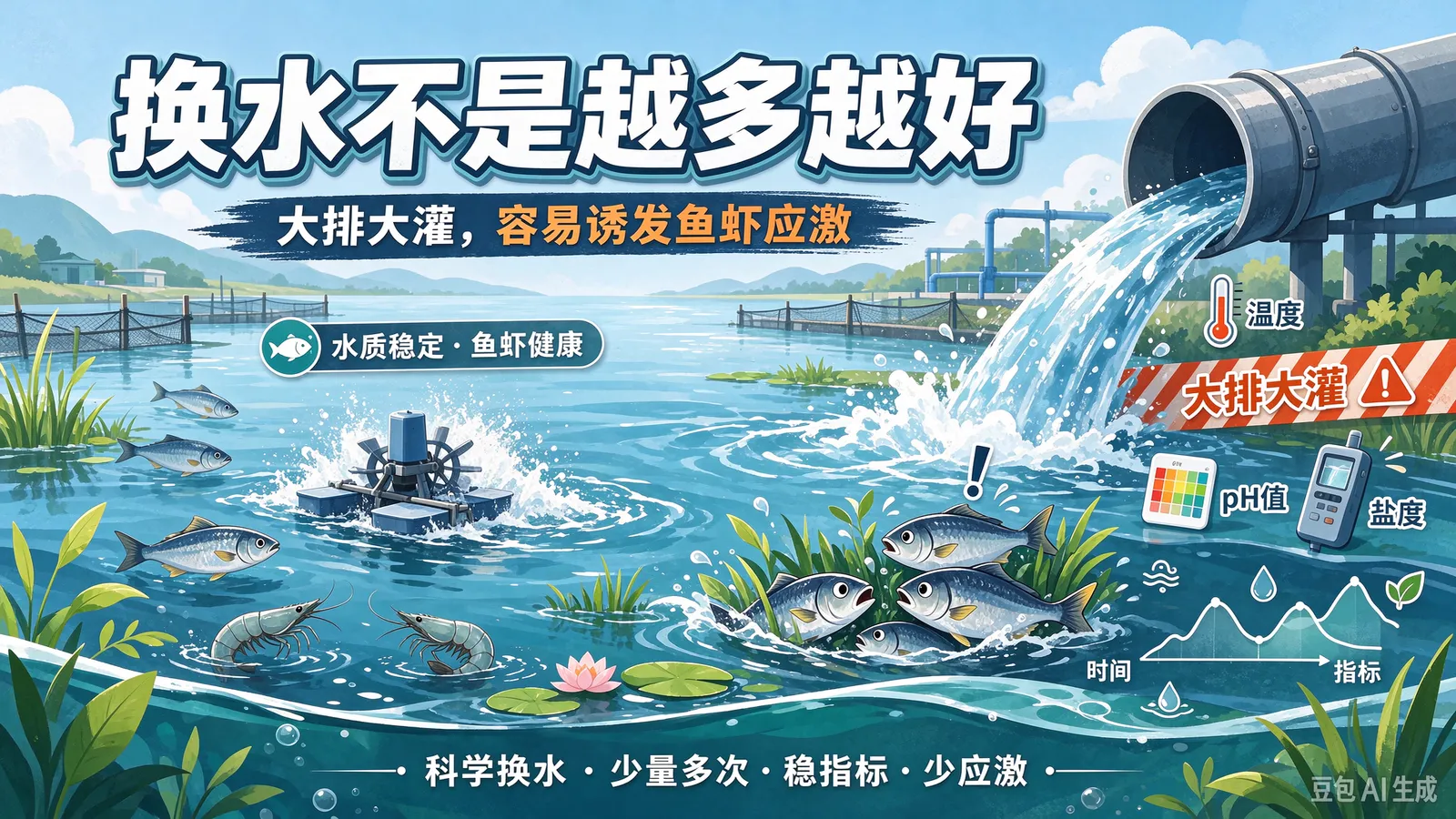
1. A Common Misconception: Does Changing Water More Often and in Larger Amounts Mean Cleaner, Healthier Fish?
When farmers notice darkening water, slow feeding in fish and shrimp, or a dirty pond bottom, their first reaction is often to drain most of the water and replace it with a batch of clean fresh water. Intuitively, old water is dirty and new water is clear, so several large exchanges should do no harm. In real aquaculture, however, a massive, sudden water exchange is often not a lifesaver—it can be the last straw that breaks the fish and shrimp.
Fish and shrimp are poikilothermic (cold-blooded) animals; their metabolism, immunity, and osmoregulation all follow the surrounding water. In a stabilized pond, temperature, pH, salinity, dissolved oxygen, microbial communities, ammonia nitrogen, and nitrite have already formed a relatively balanced “mini-ecosystem.” Draining and refilling large volumes at once overturns this balance in a short time. The animals have no time to adapt, their bodies enter a stressed state, their resistance drops, and diseases easily take advantage of the situation.
The Ministry of Agriculture and Rural Affairs and local aquaculture technical extension services repeatedly emphasize in their guidance that water should be added and exchanged in small amounts, gradually, while keeping parameters stable—not drained and refilled all at once. Below, we explain layer by layer why stress occurs, which parameters are most dangerous, and how water should actually be changed.
2. What Actually Happens During a Massive Water Exchange? A Step-by-Step Stress Chain
Many people think “stress” just means fish jumping around or hiding. In fact, it is a whole chain reaction after the body’s balance is disrupted. After a large water exchange, the situation usually develops along the following chain:
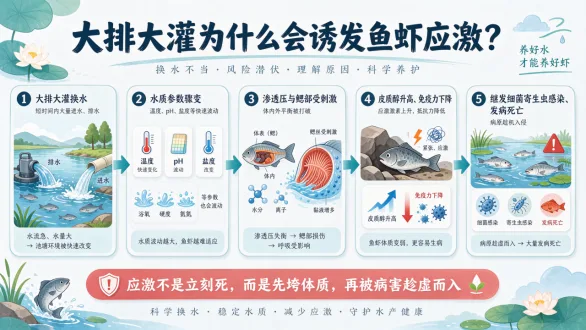
Figure 1. The chain of stress triggered in fish and shrimp by a massive water exchange
· Step 1: Sudden shifts in water parameters. Fresh and old water often differ in temperature, pH, salinity, hardness, residual chlorine, and microbial communities. After being mixed in large amounts at once, the parameters fluctuate sharply within a short period.
· Step 2: Irritation of the gills and osmoregulation. The gills are the organs of respiration and ion exchange. Sudden changes in salinity and pH directly irritate the gill mucosa; the animal also has to work hard through the gills and kidneys to maintain osmotic balance between its body and the water, consuming large amounts of energy.
· Step 3: Stress hormones rise and immunity declines. The body interprets the abrupt environmental change as a “threat.” Stress hormones such as cortisol rise: in the short term they mobilize energy to cope, but in the long term they suppress immunity, feeding, and growth.
· Step 4: Secondary disease infection. After physical condition and immunity decline, bacteria, parasites, and opportunistic pathogens that were already present in the water at low numbers begin to multiply, eventually leading to problems such as gill rot, enteritis, skin ulceration, silent mortality, and death from dissolved-oxygen depletion.
It is especially important to note that stress often does not kill fish and shrimp on the spot. It first drains their physical condition; only when disease breaks out a few days later do farmers recall the large water exchange from earlier. This is why many problems after a water change are difficult to attribute directly to it.
3. When Old and New Water Mix, Which Parameters Are “Clashing”?
Fish and shrimp are far more sensitive to changes in the water environment than humans. A person barely notices changing a basin of water indoors, but fish and shrimp are immersed in water their whole bodies; every breath and every patch of skin interacts with the water. The four parameter groups below are the most likely to cause problems during a massive water exchange.
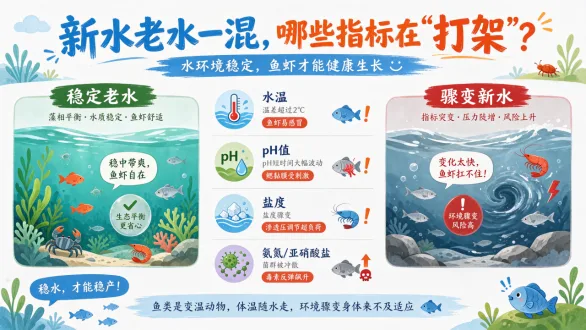
Figure 2. Comparison of key parameters between stable old water and abruptly changed new water
3.1 Water Temperature: Poikilothermic Animals Whose Body Temperature Follows the Water
Fish have no constant body temperature; their body temperature is essentially equal to the water temperature they live in. A rapid rise or fall in water temperature directly affects enzyme activity, metabolic rate, and immune status. In aquaculture practice, the temperature difference between new and old water is generally kept within 2°C, and even more strictly for delicate stages such as fry and shrimp larvae. An excessive temperature difference can cause what is known as “cold shock”—schooling together, darting around, crowding near the edge, and stopping feeding—followed by secondary infection.
3.2 pH: Fluctuation Is More Dangerous Than the Absolute Value
pH indicates the acidity or alkalinity of the water. According to GB 11607—89, Water Quality Standard for Fisheries, the suitable pH range is 6.5–8.5 for freshwater and 7.0–8.5 for seawater. Note that pH is a logarithmic scale: a difference of 1 pH unit means about a tenfold difference in acidity or alkalinity. If slightly alkaline new water is suddenly added to a pond of slightly acidic old water, pH rises sharply within minutes, irritating the gill mucosa and body mucus; a sudden drop is equally dangerous. Often, what actually harms the fish is not a high or low pH per se, but the fact that it jumps back and forth violently in a short time.
3.3 Salinity and Osmotic Pressure: Regulatory Organs Working Overload
Fish and shrimp rely on their gills, kidneys, and body surface to maintain water and salt balance between the inside and outside of the body. When salinity changes abruptly, freshwater fish face a large influx of water into the body, while marine fish face water loss; the osmoregulatory system is forced to operate at high load. Both research and production practice show that a rapid drop in salinity is especially likely to disrupt blood parameters and immune status; shrimp and crabs are even more sensitive to salinity changes during molting.
3.4 Ammonia Nitrite, Nitrite, and Microbial Communities: The Old-Water Ecosystem Is Dispersed
In a stable pond, beneficial bacteria such as nitrifying bacteria attach to the bottom mud, filter media, and aquatic plants. They convert ammonia nitrogen produced from fish/shrimp feces and uneaten feed step by step into relatively low-toxicity nitrate. A massive water exchange disperses large numbers of these bacteria, weakening the nitrification buffer capacity and allowing ammonia nitrogen and nitrite to rebound and spike.
Nitrite damages the oxygen-carrying capacity of the blood. Even when dissolved oxygen does not look low, the gill filaments may turn dark red and the animals may suffocate and die silently. Ammonia nitrogen becomes proportionally more toxic at higher pH and temperature, and damages both the gills and the liver and kidneys.
4. Understand These Water-Quality “Safety Lines” Before Changing Water
Before changing water, measuring the water clearly matters far more than draining it by feel. The table below lists commonly used reference ranges for key parameters in freshwater aquaculture, for use in routine pond inspection and before/after water changes. For specific species (such as shrimp, crabs, special-purpose fish, or larval stages), the limits should be tightened according to the relevant technical regulations.
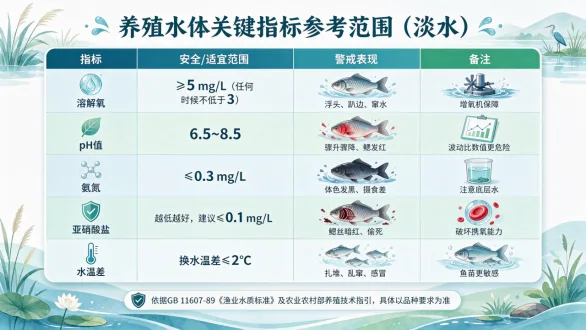
Figure 3. Reference ranges for key parameters in freshwater aquaculture water
Table 1. Reference key water-quality parameters for freshwater aquaculture (compiled from GB 11607—89 and the Ministry of Agriculture and Rural Affairs aquaculture technical guidance)
| Parameter | Safe / Suitable Range | Warning Signs | Notes |
| Dissolved oxygen (DO) | ≥5 mg/L; never below 3 mg/L at any time | Surface gulping, crowding at edge, darting, silent mortality | Maintained jointly by aerators and water exchange |
| pH | 6.5–8.5 (freshwater) | Sharp rise/fall, red gills, abnormal body mucus | Fluctuation range is more dangerous than a single value |
| Ammonia nitrogen | Recommended ≤0.3 mg/L | Darkened body color, poor feeding, surface gulping | Pay attention to bottom-layer water |
| Nitrite | The lower the better; recommended ≤0.1 mg/L | Dark red gill filaments, gradual silent mortality | Damages blood oxygen-carrying capacity |
| Water-change temperature difference | New–old water temperature difference ≤2°C | Schooling, darting, crowding at edge, stopped feeding | More sensitive in fry and shrimp larvae stages |
5. How Should Water Be Changed? Remember the Six-Step Method: Small Amounts, Gradual, Stable Parameters
Water can and should be changed, but in a rhythmic, evidence-based way. Combining the Ministry of Agriculture and Rural Affairs’ *Guidelines for Autumn Aquaculture* and *Guidelines for Summer Aquaculture* with the operational advice of local aquaculture extension services, scientific water exchange can be carried out in the following six steps.
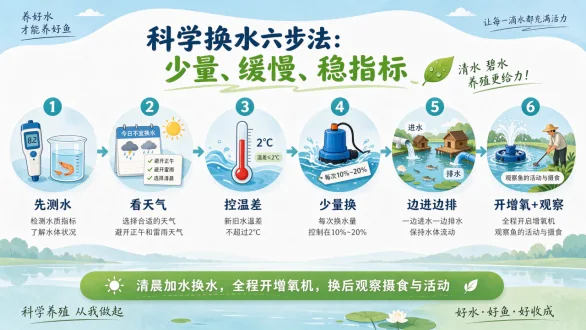
Figure 4. Six-step method for scientific water exchange
Step 1: Test the Water First, Then Decide Whether to Change It
Before changing water, measure the temperature, pH, dissolved oxygen, ammonia nitrogen, and nitrite of both pond water and source water; measure salinity and hardness if possible. If parameters fluctuate only slightly and feeding and activity are normal, prioritize adjustment through aeration, bottom improvement, algae cultivation, and reasonable feeding. Water exchange should be considered only when water quality has clearly deteriorated, transparency has been persistently too low, toxins exceed limits, and other measures have failed.
Step 2: Check the Weather and Choose the Right Time Window
Add or change water preferably in the early morning, avoiding midday heat, the evening period when surface gulping may begin, and thunderstorm, sultry, or sharp-cooling weather. On rainy days and at night, dissolved oxygen is already tight; a massive water exchange at such times is more likely to cause stress and hypoxia.
Step 3: Control Temperature and Salinity Differences; Let the New Water “Settle” First
Compare temperatures before pumping in new water, keeping the difference within 2°C where possible. If conditions allow, set up a storage pond where new water can be sunned, aerated, and allowed to balance in temperature and quality before being introduced. When using tap water, watch for residual chlorine and aerate in advance to remove it. In marine and brackish-water farming, the magnitude of salinity change must also be controlled and introduced in multiple transitional steps.
Step 4: Change in Small Amounts; Do Not Greed for Volume in a Single Exchange
In routine farming, fresh water is generally added once every 7–10 days, with a single exchange controlled at 10%–20% of the total pond volume; in hot weather with deteriorated water quality this may be raised appropriately to 20%–30%, but it should still be done in multiple portions. Local regulations also commonly specify “10%–20% per exchange, draining bottom-layer water first before replenishing new water.” Never drain more than half the pond at once, and never replace the entire pond with new water.
Step 5: Inflow and Outflow Simultaneously; Drain Dirty Bottom Water First
Use simultaneous inflow and outflow. Place the drain at the bottom to first discharge accumulated uneaten feed, feces, and eutrophicated bottom water, then slowly replenish new water. Do not drain only the clear upper water while leaving the dirty bottom water behind; distribute the inlet as much as possible to avoid directly flushing the pond bottom and fish/shrimp schools.
Step 6: Run Aerators, Observe Closely, and Follow Up After the Exchange
Keep aerators running throughout the water addition and exchange to mix upper and lower water layers, balance temperature, and replenish dissolved oxygen. Afterward, focus on observing feeding, activity, body color, gill color, and whether the animals crowd near the edge or school together. If stress signs appear, use anti-stress and water-stabilizing products according to farming regulations to aid recovery, while continuing to monitor parameters and avoid repeated disturbance.
6. Questions Farmers Ask Most Often
6.1 The Water Is Too Rich and Transparency Is Low—Can I Exchange a Larger Amount at Once to “Flatten” It?
It is not advisable to rely on a massive water exchange to “reduce richness.” Over-concentrated water color is usually related to feeding rate, bottom condition, and algal composition. A more reliable approach is to first aerate, improve the bottom, and reasonably reduce feeding, then change water in small multiple portions together with algae cultivation and water conditioning. A large one-time exchange both disrupts the algal community and microbial flora and easily triggers stress, which may instead make the water color even less stable.
6.2 Fish and Shrimp Have Just Started Gulping at the Surface or Dying—Should I Rush a Large Water Exchange to Rescue Them?
When surface gulping occurs, the first priority is aeration, not an immediate large water exchange. Start aerators and, if necessary, apply oxygen-enhancing products to stabilize dissolved oxygen. After the animals’ condition eases, determine whether the cause is hypoxia, toxin excess, or disease, and carry out targeted small water exchange or treatment. Under hypoxic conditions, a massive water exchange—the disturbance and parameter fluctuation brought by new water—may accelerate mortality.
6.3 Is New Water Better the Cleaner It Is? Can Well Water or Tap Water Go Straight into the Pond?
The source water must be clean, pollution-free, and rich in dissolved oxygen, but that does not mean it can be pumped straight in. Well water is often low in temperature and dissolved oxygen and may contain iron, manganese, and other substances; tap water contains residual chlorine. Such water should first enter a storage pond to be sunned, aerated, and settled, balancing temperature and quality. Only after parameters are confirmed to be close to those of the pond should it be introduced slowly.
6.4 After the Water Change, the Animals Stop Feeding, School Together, or Rub Against the Bottom—What Should I Do?
These are often signs of stress or water-quality irritation. Stop adding or changing water first, increase aeration, and re-measure temperature, pH, dissolved oxygen, ammonia nitrogen, and nitrite. Keep the environment quiet and reduce extra operations such as netting, medication, and parasite treatment. If the condition does not improve or dead fish appear, contact the local aquaculture extension service or a veterinarian promptly to distinguish stress, toxins, or disease before applying targeted treatment.
7. Conclusion: Good Water Is “Cultured,” Not “Exchanged”
The core of aquaculture water is stability. A pond in which temperature, pH, dissolved oxygen, salinity, microbial flora, and toxin indicators are balanced with one another protects fish and shrimp better than a batch of clear-looking new water of unknown origin. The purpose of water exchange is to replenish fresh water, discharge bottom-layer wastewater, and adjust water quality—not to overturn the old water entirely and start over.
Remember three sentences: small amounts and multiple times, gradual transition; test before changing, follow up with aeration; stable parameters matter more than clear water. Treat water exchange as a fine, rhythmic part of routine management rather than a “strong medicine” after problems arise. When fish and shrimp experience less stress and fewer diseases, farming returns remain stable.
References
· GB 11607—89, Water Quality Standard for Fisheries: pH 6.5–8.5 for freshwater and 7.0–8.5 for seawater; dissolved oxygen above 5 mg/L for more than 16 hours in any 24-hour period, and never below 3 mg/L at any other time.
· Ministry of Agriculture and Rural Affairs, Bureau of Fisheries: Guidelines for Autumn Aquaculture and Guidelines for Summer Aquaculture—add fresh water once every 7–10 days, use aerators reasonably, and strengthen monitoring of pH, ammonia nitrogen, and nitrite.
· Department of Agriculture and Rural Affairs of Guangdong Province: Freshwater Pond Aquaculture Technology—change water once every 15 days, at 10%–20% of pond volume per exchange, and 20%–30% in the hot season.
· Aquaculture management guidance from Yancheng, Huai’an, and other regions: keep a single addition/exchange at 10%–20% of total volume, avoid midday and nighttime, run aeration equipment throughout, and reduce stress.
· Fish are poikilothermic animals; abrupt changes in temperature, dissolved oxygen, salinity, and pH can affect immunity and osmoregulation. The mechanisms are based on publicly available research on environmental stress in aquatic animals and the relationship between water quality and fish disease.
Note: The parameters in this article are general reference ranges. For specific species, larval stages, and intensive production systems, the relevant species technical regulations and the advice of local aquaculture technical authorities should be followed.