
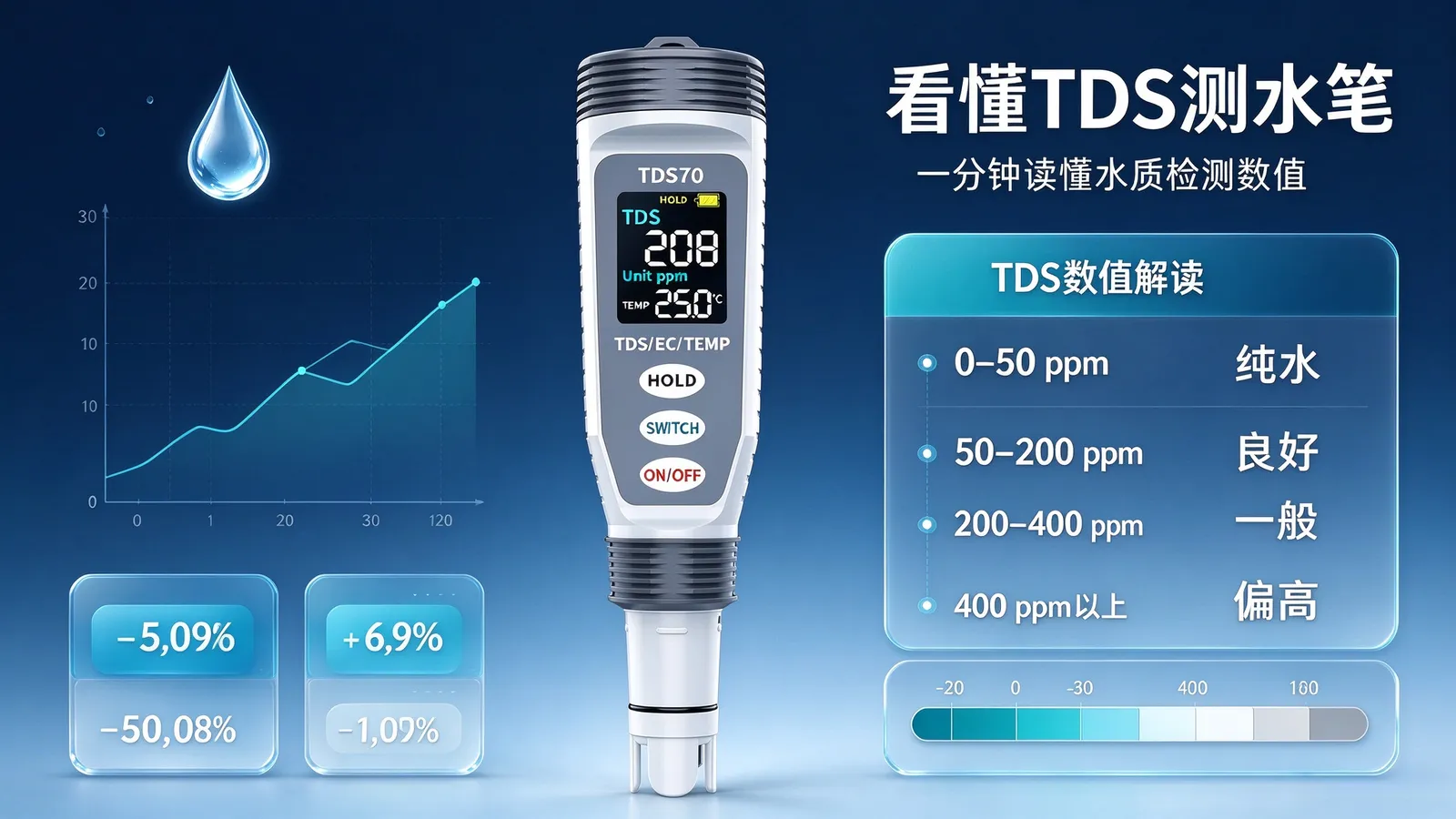
1. First: what does TDS actually measure?
TDS means Total Dissolved Solids — roughly the total of soluble inorganic salts and a small amount of organics dissolved in water, in mg/L (ppm).
A TDS meter measures conductivity and converts it to a TDS reading.
✅ It can detect: dissolved substances that conduct electricity (calcium/magnesium ions, sodium/potassium, salts, etc.)
❌ It cannot detect: bacteria, viruses, many heavy-metal ions (some don’t conduct well), residual chlorine, pesticide residues, antibiotics, algal toxins, and more.
That’s why: low TDS ≠ safe water, high TDS ≠ toxic water.
Two easy examples:
- Qualified natural mineral water can have hundreds of ppm TDS because of calcium and magnesium — yet it can be safe, good drinking water;
- If non-conductive toxic organics enter the water, TDS can look low while the water is already polluted and undrinkable.
Judging drinkability from TDS alone is a misconception.
2. Beyond “good vs bad water”: what TDS meters are really useful for
1. Monitoring RO (reverse osmosis) purifiers — the most common use
This is the #1 use case for TDS meters.
RO membranes mainly reject dissolved salts.
In practice:
- Measure source-water TDS (tap water)
- Measure product-water TDS at the pure-water outlet
Comparing the two shows desalination performance.
Track readings over time: - New membrane: stable rejection, very low product TDS;
- After some use, if product TDS keeps rising clearly (and pressure/temperature aren’t the cause), the RO membrane is likely degrading and may need replacement.
👉 Important: it cannot prove the water is free of bacteria or residual chlorine. But for home users, it’s the simplest low-cost way to check whether the RO membrane is still working. Many purifier service teams use TDS meters for routine checks.
2. Comparing water sources quickly
Even tap water varies by building, neighborhood, and pipe aging — TDS can differ;
Tap, well, spring, and bottled water often show clear TDS differences.
When collecting water outdoors or using well water at home, a TDS meter gives a quick baseline: is dissolved-salt content relatively high or low?
For example, well water consistently above 1,000 ppm suggests high minerals/salts — worth follow-up hardness or heavy-metal testing.
Reminder: this is only a reference. High-TDS well water isn’t automatically harmful, but it’s not recommended for drinking untreated.
3. Aquaculture, aquariums, and water features
Ornamental fish, planted tanks, and hatcheries are sensitive to total dissolved salts.
Different plants and tropical fish prefer different TDS ranges:
- South American dwarf cichlids prefer low-TDS soft water;
- African rift-lake cichlids prefer higher-TDS harder water;
When changing water, check the gap between new water and tank water with a TDS meter to avoid big swings that stress or kill livestock.
Ponds and decorative water features can also use TDS as one supporting metric alongside others.
4. Irrigation, hydroponics, and soilless culture
In hydroponics, nutrient concentration drives growth. TDS is a practical proxy for nutrient strength:
Too low → underfeeding; too high → root burn risk.
Farms and hydroponic sites often use TDS meters for daily checks and mother-solution dosing.
Irrigation water can also be checked regularly; persistently high salts may cause secondary soil salinization over time.
5. Industrial cleaning, boiler water, and circulating water checks
In small boilers and cooling loops, high dissolved salts promote scale and corrosion.
Staff can track TDS (with hardness) to decide on blowdown, water changes, or antiscalant dosing.
Ultrasonic cleaning and some pure-water process steps also use TDS as a simple in-process check.
6. Commercial RO / direct-drinking equipment O&M
Tea shops, cafés, and cafeteria drinking systems often use RO.
Daily TDS spot-checks help confirm the system hasn’t failed — avoiding bad taste and scale when membranes fail.
Coffee and tea are sensitive to mineral content; TDS is a common quick reference in the industry.
3. The right mindset: a helper tool, not a universal water tester
Remember these boundaries:
- ❌ Cannot alone decide if water meets drinking-water standards such as China’s GB 5749;
Full CMA lab testing is required for compliance decisions; - ❌ Cannot detect bacteria, viruses, residual chlorine, or organics;
- ✅ Best for before/after comparison and long-term trend monitoring, not one-shot pass/fail;
- ✅ Strengths: cheap, portable, fast readings, zero learning curve — good for homes, shops, and sites.
In one line:
A TDS meter can’t “verdict” water quality — but it’s a low-cost, always-on trend watcher.
It won’t tell you if water is toxic, but it can show whether dissolved salts changed — helping you catch RO failure, source shifts, or abnormal nutrient strength early.