
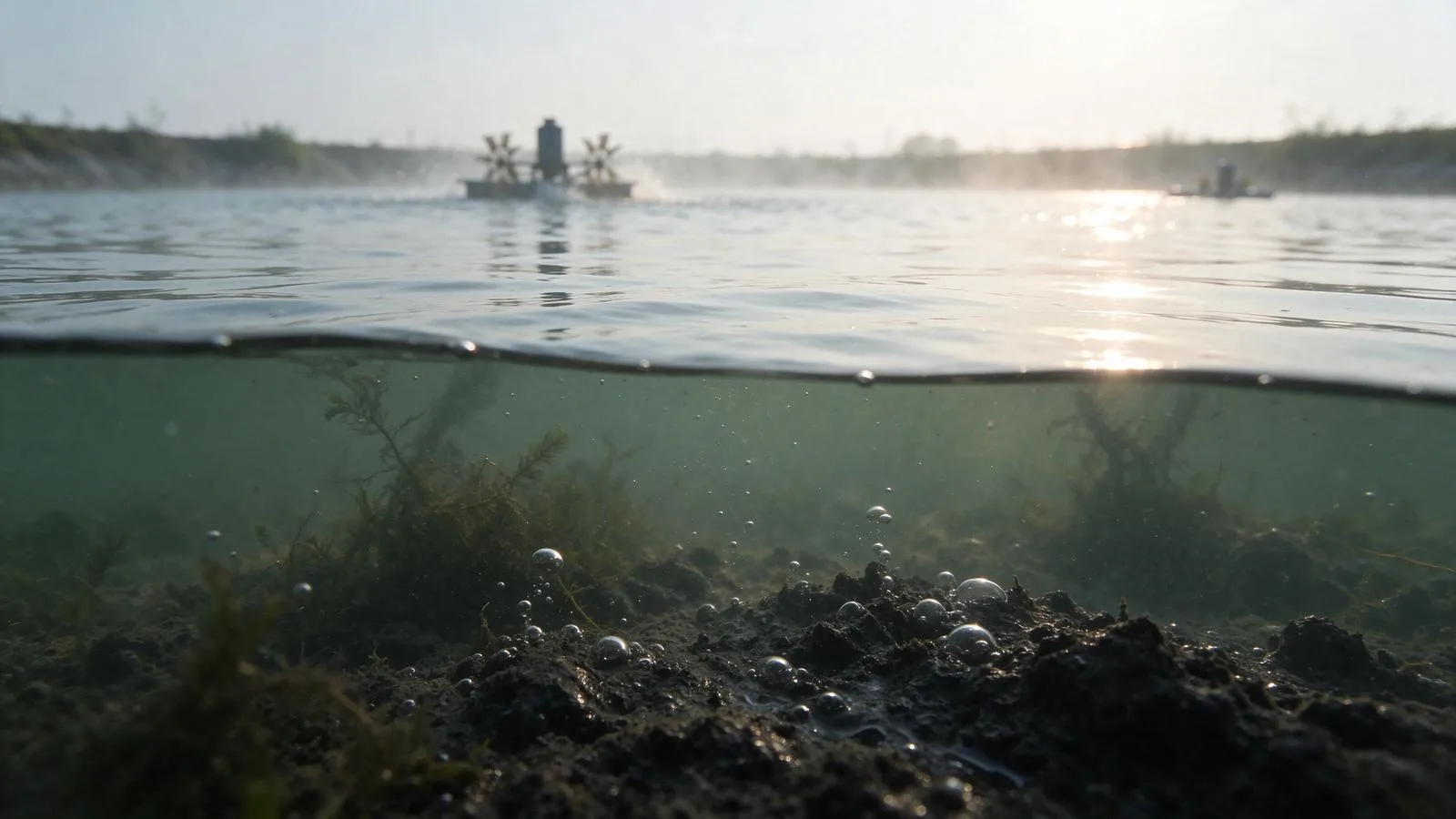
Abstract: The water looks clear by day, yet the fish gasp at dawn; feed conversion drops, medications keep failing, and disease recurs again and again. Often the root cause is not on the water surface but in the invisible pond bottom. This plain-language article explains where pond sludge comes from, why it turns black and odorous, what harm thick black sludge causes, how to self-check, what the national standard limits are, and the full control chain from source reduction and routine bottom management to desilting and pond drying. It is written for aquaculture farmers, farm technicians, aquatic-product dealers, and readers interested in water-quality testing.
Keywords: pond sediment, black odorous sludge, stinking pond bottom, hydrogen sulfide, ammonia nitrogen, nitrite, sediment improvement, bottom remediation, desilting and pond drying, aeration, pond turnover, fish kill, sludge thickness standard, fishery water quality standard, aquaculture water quality management
1.A Familiar Scenario
Many farmers have seen this pattern:
- On the daytime patrol, the water color looks acceptable and there are no obvious dead fish;
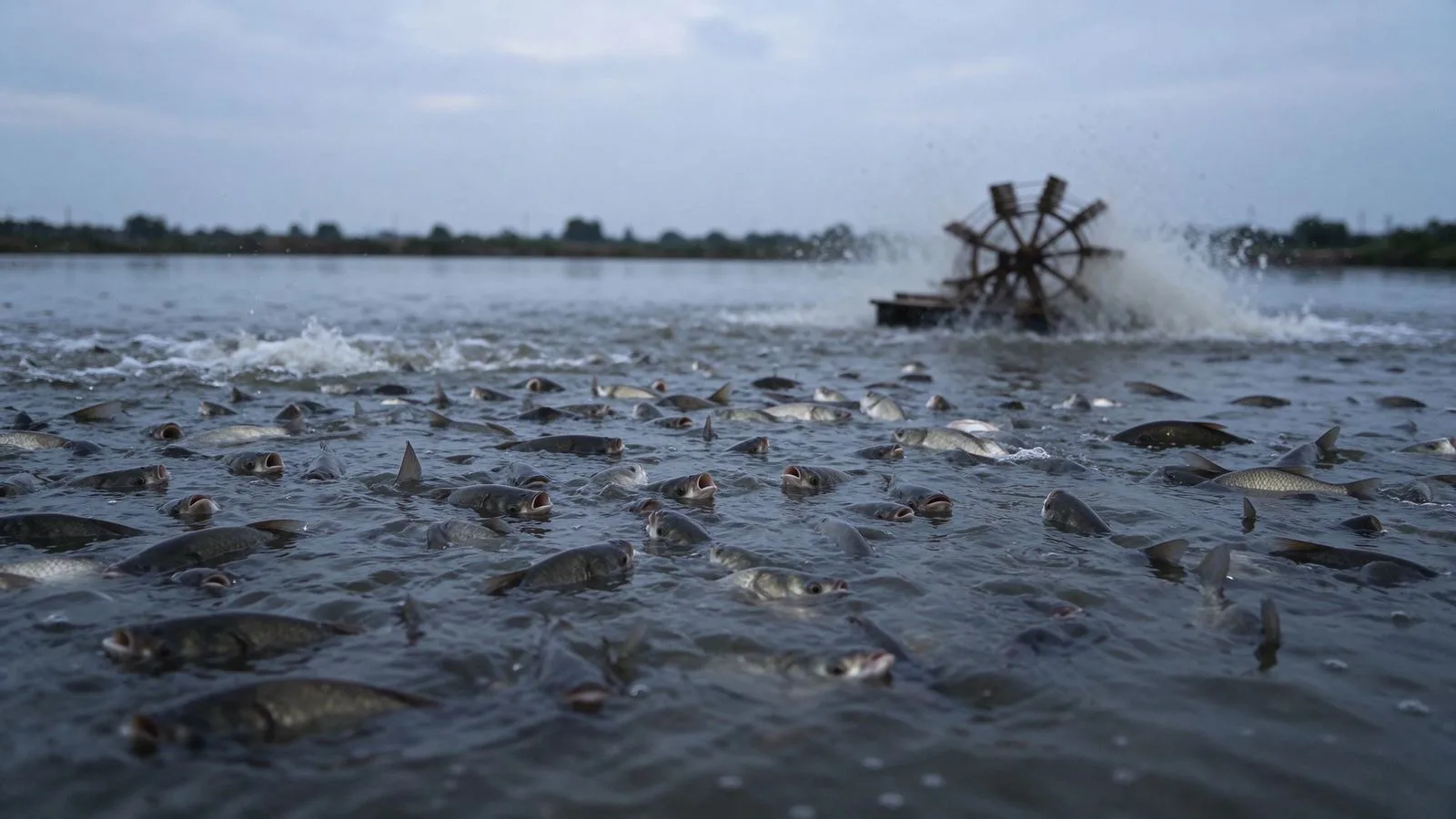
- Late at night, toward dawn, the fish start gasping at the surface, and turning on the aerator does not help much;
- Feed intake keeps declining, growth is uneven between animals, and bacterial and parasitic diseases keep recurring;
- When the pond is drained, a thick layer of black mud has accumulated on the bottom; one shovel brings up an acidic, rotten-egg smell that hits the nose.
The problem often lies not on the surface but on the bottom. The pond bottom is the whole pond's "trash can" and "fertilizer bank," and at the same time the storage room for toxins and pathogens. The quality of the bottom directly determines whether the water stays stable and whether the fish and shrimp are robust. As the industry saying goes: "In farming you first raise the water; to raise the water you first restore the bottom."
2.Where Does the Pond Sludge Come From?
During farming, the following materials continuously settle to the bottom:
- Uneaten feed: over-feeding, poor palatability, or feed stopped after a sudden weather change leaves leftover feed on the bottom;
- Fish and shrimp feces and excreta: the higher the stocking density, the faster the bottom accumulates waste;
- Dead algae, plankton, and animal and plant remains: after an algal crash or water-color shift, large amounts of dead algae sink;
- Sediment washed in by rain: soil erosion from pond dikes deposits mud slurry;
- Fertilizer and organic residues: leftovers from fertilizing and water conditioning.
It should be noted that a moderate layer of sludge in the pond is not a bad thing. Colloids in the sludge adsorb and hold nutrients such as nitrogen, phosphorus, and potassium, releasing them slowly when needed. They supply and retain fertilizer and buffer the fertility of the water. Newly built ponds often swing between too rich and too lean largely because they lack this sludge layer to act as a buffer.
However, too much of anything is harmful. When sludge keeps thickening and the rate of organic-matter decomposition cannot keep up with deposition, this "fertilizer bank" turns around and becomes an internal pollution source.
3.Why Does a Sound Pond Bottom Turn Black and Smelly?
3.1 Aerobic decomposition: the normal state of a clean bottom
Under well-oxygenated conditions, aerobic bacteria break down organic matter — leftover feed, feces, dead algae — into relatively harmless products such as carbon dioxide, water, nitrate, and sulfate. The nutrients are reused by algae and the water body, forming a benign cycle. The sediment at this stage is usually yellow-brown or light brown, with a normal earthy, muddy smell.
3.2 After oxygen runs out: anaerobes take over and toxins begin to form
When too much organic matter accumulates at the bottom and oxygen cannot be replenished, the bottom enters an anaerobic (oxygen-depleted) state. Anaerobic and facultative anaerobic bacteria multiply rapidly; organic matter is only partially decomposed, leaving a batch of harmful "half-finished" products:
- Ammonia nitrogen (ammonia / ammonium): a product of protein and nitrogenous organic matter decomposition;
- Nitrite: an intermediate in the conversion of ammonia to nitrate;
- Hydrogen sulfide (H₂S): produced from sulfur-containing organic matter by sulfate-reducing bacteria under oxygen-depleted conditions;
- Methane, low-molecular-weight organic acids, and other reduced products.
3.3 Why does the bottom turn black? Where does the smell come from?
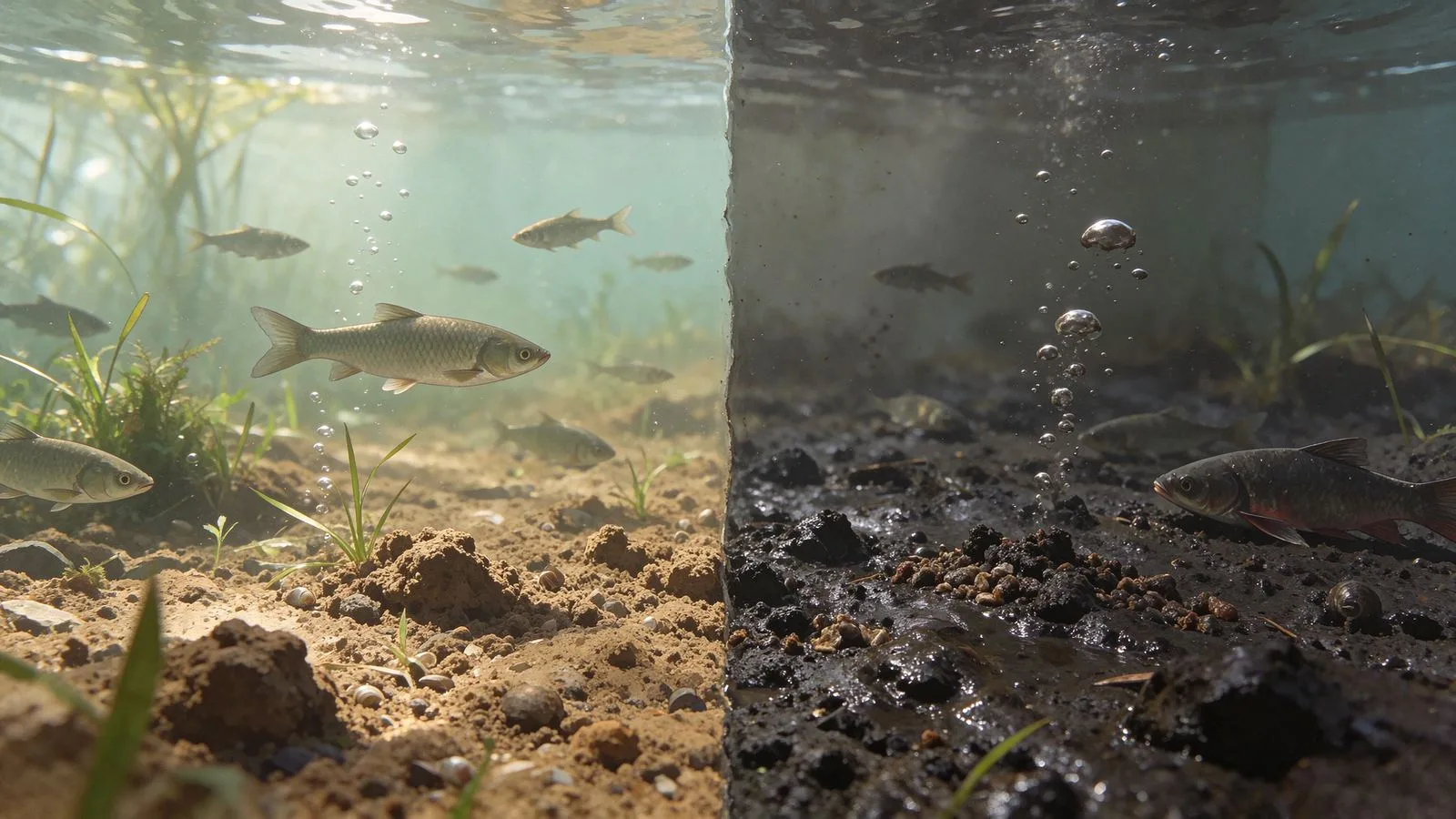
When hydrogen sulfide meets metal ions such as iron and manganese in the sediment, it forms black iron sulfide and manganese sulfide precipitates mixed into the sludge, and the bottom turns black. Hydrogen sulfide itself carries the typical rotten-egg odor; organic acids and amines released from fermenting decaying organic matter add the acidic, fishy stench.
So "black sediment + foul smell" are not two separate events. They are one and the same signal: the bottom has been chronically oxygen-depleted and is in a degraded, reduced state.
4.What Harm Do Thick, Black, Odorous Sludge Layers Cause?
Harm 1It steals bottom oxygen and builds up an "oxygen debt"
Many people assume that at night the water oxygen is mainly consumed by fish respiration. Measurements in intensive ponds show the night-time oxygen consumption breakdown: fish respiration accounts for only about 15%–25%, phytoplankton respiration about 30%–40%, while decomposition of organic matter in the bottom sediment accounts for about 40%–60%.
In other words, the biggest "oxygen thief" is often not the fish but that thick layer of sludge. By daytime the problem is hidden because algae photosynthesize and produce oxygen; once photosynthesis stops at night, the whole pond only consumes oxygen without producing it, and the bottom layer runs out first. Between 3 a.m. and 5 a.m. the pond's oxygen reserve is thinnest and the stock is most vulnerable.
Harm 2Continuous toxin release — chronic poisoning and acute damage
- Ammonia nitrogen: irritates and damages gill tissue, lowering respiration and metabolism; animals eat poorly, grow slowly, and become highly stressed. Ammonia toxicity is closely tied to water temperature and pH — the higher the temperature and pH, the larger the share of molecular ammonia (unionized ammonia), and the stronger the toxicity.
- Nitrite: enters the blood through the gills and oxidizes hemoglobin into methemoglobin, which cannot carry oxygen. Blood and gills turn from bright red to brown-red and coffee-brown — commonly called "brown blood disease." Even when dissolved oxygen in the water is not low, the animals cannot use the oxygen; they show surface gasping, darting, sluggish responses, and reduced feeding.
- Hydrogen sulfide: highly toxic; even a low concentration inhibits cellular respiration. Typical poisoning signs include gasping during daytime with little improvement after aeration, a rotten-egg smell at the bottom, and bottom-dwelling fish (such as carp) dying first.
- Methane, organic acids, and others: further acidify the sediment and worsen the environment, keeping the animals in long-term stress.
Harm 3A breeding ground for pathogens and parasite eggs
The low-oxygen, nutrient-rich bottom is exactly the kind of place where opportunistic pathogens such as Vibrio and parasite eggs like to multiply. Industry statistics note that about 70% of harmful bacteria are anaerobic or facultative anaerobic. Once the bottom degrades, pathogens multiply fast; animals weaken and their resistance drops, so enteritis, gill rot, and parasitic diseases tend to break out repeatedly. Dead fish and shrimp sink and continue to decompose, forming a vicious cycle: worse bottom → sicker fish → even worse bottom.
Harm 4It drives out harmful algae such as cyanobacteria and dinoflagellates
Nitrogen and phosphorus stored in the sediment are released slowly and can enrich the water. After the bottom acidifies, trace elements such as calcium, magnesium, iron, and manganese deposit as insoluble salts, suppressing beneficial algae; nutrient-loving cyanobacteria and dinoflagellates instead become the dominant species, bringing sudden water-color shifts and a higher risk of algal crashes and water turnover.
Harm 5It raises the bottom and compresses the usable rearing space
Sludge continuously raises the pond bottom, shrinking the actual water depth and effective water volume. Stocking density and yield are both limited, and with insufficient water space the water quality fluctuates more easily.
Harm 6A weather change can stir up the toxins and cause a "pond turnover"
On calm summer days the surface water is warmed by the sun and stays light, while the bottom water is cold and heavy; a stable vertical stratification forms (thermocline and oxycline), locking the oxygen-depleted, toxic bottom water underneath. When an afternoon thunderstorm, night cooling, or cold wind arrives, the cold surface water sinks and the layers mix. The hydrogen sulfide, ammonia, and other reduced substances accumulated in the bottom are suddenly spread through the whole pond, and the little oxygen left at the surface can be exhausted within tens of minutes, causing acute whole-pond hypoxia and poisoning, widespread surface gasping, and even total fish kill. This is the "turnover" that farmers fear most.
5.How to Tell If Your Pond Bottom Is in Trouble: A Four-Step Self-Check
Step 1: Check thickness and color
Push a long pole or probe into the bottom to estimate sludge thickness:
- For intensive ponds, sludge thickness is generally kept within 10–20 cm;
- If it exceeds 20–30 cm and the pole sinks deep easily, desilting is urgent;
- Dig out some sediment: brown, loose material is healthy; jet black, sticky, with obvious bubbles is a degradation signal;
- Long-term transparency below 20–30 cm, high suspended solids, or a sudden thickening or clearing of the water color also call for caution.
Step 2: Smell it
- Normal: earthy, muddy smell;
- Rotten-egg smell: indicates hydrogen sulfide;
- Acidic, rotten, fishy stench: indicates excess decaying organic matter and an acidified bottom.
Step 3: Test the parameters (bottom water matters most)
Do not test only the surface water; sample about 5 cm above the pond bottom. Common reference limits are as follows:
| Parameter | Standard / Reference Requirement | Source |
|---|---|---|
| Dissolved oxygen (DO) | Over any continuous 24 h, more than 16 h above 5 mg/L, and never below 3 mg/L at any other time; bottom DO below 2 mg/L is high risk | GB 11607—89, Water Quality Standard for Fisheries |
| pH (freshwater) | 6.5–8.5 | GB 11607—89, Water Quality Standard for Fisheries |
| Unionized ammonia | ≤ 0.02 mg/L | GB 11607—89, Water Quality Standard for Fisheries |
| Sulfide | ≤ 0.2 mg/L (in production management, hydrogen sulfide is kept below 0.1 mg/L) | GB 11607—89; local aquaculture technical guidance |
| Nitrite (NO₂⁻-N) | Code requirement ≤ 0.01 mg/L; above 0.1 mg/L chronic poisoning is likely | DB11/T 1869—2021; local aquaculture technical guidance |
| Ammonia nitrogen (total ammonia) | In practice, generally kept below 0.2 mg/L; actual toxicity must be converted to unionized ammonia considering pH and temperature | Local aquaculture technical guidance |
Step 4: Watch fish and shrimp behavior
Add bottom-quality problems to the checklist when you see:
- Frequent surface gasping at dawn or in muggy weather, with little relief after aeration;
- Animals hugging the edges, skimming along the bank, swimming alone, or lying listless with low vitality and slow response;
- Abnormal gill color (brown, purplish, swollen) and reduced feed intake;
- Uneven growth sizes, "silent mortality," or dead shrimp and fish on the bottom;
- Strong stress after medication, with water-quality indices repeatedly bouncing back.
Healthy Bottom vs. Degraded Bottom
| Observation | Healthy Bottom | Degraded Bottom |
|---|---|---|
| Sediment color | Yellow-brown, light brown, loose | Jet black, gray-black, sticky and compacted |
| Smell | Earthy, muddy | Rotten-egg, acidic, foul fishy stench |
| Sludge thickness | Within 10–20 cm | Over 20–30 cm |
| Bottom DO | Sufficient; no bottom hypoxia | Chronically low, below 2 mg/L |
| Surface state | Stable water color, normal transparency | Turbid, foamy, prone to algal crash |
| Stock performance | Strong feeding, good vitality, even sizes | Gasping, edge-hugging, discolored gills, silent mortality, frequent disease |
| Harmful substances | Ammonia, nitrite, sulfide within limits | Multiple indices repeatedly over limit |
6.Relevant National Standards and Industry Codes
Bottom management is not a matter of guesswork; current national standards and local technical codes provide clear basis:
- GB 11607—89, Water Quality Standard for Fisheries: sets basic limits for dissolved oxygen, pH, unionized ammonia, sulfide, and other parameters in fishery waters;
- NY/T 5361, Environmental Conditions for Producing Safe Agricultural Products — Freshwater Aquaculture Sites: sets requirements for the culture bottom environment;
- DB11/T 1869—2021, General Technical Specification for Pond Aquaculture: earthen ponds should have excess sludge removed, preferably to less than 10 cm thickness, and the bottom sun-dried for 5–7 days after desilting; pond DO not lower than 3 mg/L, pH 6.8–8.5, unionized ammonia no higher than 0.02 mg/L, nitrite no higher than 0.01 mg/L;
- DB50/1078—2021, Integrated Technical Specification for "One Retrofit, Five Standardizations" Ecological Pond Aquaculture: remove sediment in due course; sludge thickness not to exceed 0.3 m;
- SC/T 9101, Discharge Requirements for Freshwater Pond Aquaculture Water: culture effluent must meet discharge standards;
- Local aquaculture pond-drying guidelines (e.g., the version issued by the Guangdong Provincial Department of Agriculture and Rural Affairs): keep about 10 cm of sediment after desilting to support bottom recovery and water stability; ordinary ponds are sun-dried for at least 15 days; old and black-odorous ponds are tilled and re-dried for a total of at least 30 days.
7.What to Do: A Four-Layer Defense From Source to Emergency
Layer 1: Source reduction — keep organic matter from settling
- Scientific feeding: follow fixed time, fixed location, fixed quality, and fixed quantity; aim for 70%–80% satiation, finishing each ration within 1–2 hours. Adjust the ration to weather, water temperature, and feeding response; feed little or nothing on overcast and thunderstorm days;
- Keep stocking density reasonable and avoid overloading;
- Maintain stable algae and prevent large-scale algal crashes that send dead algae to the bottom;
- Protect pond dikes with slope stabilization to reduce rain-washed sediment entering the pond.
Layer 2: Routine maintenance — preserve bottom DO and remediate the bottom regularly
1. Three-dimensional aeration is the core. Configure and run aerators properly, prioritizing bottom oxygen through the night and before dawn. Start them early in hot seasons, muggy weather, and overcast rain; break up water stratification and carry oxygen-rich surface water to the bottom. Ponds that can afford it may add bottom aeration (micro-pore diffused aeration, etc.).
2. Remediate the sediment regularly. Common bottom treatments fall into three categories:
- Physical treatment: draining and dredging, aerator-driven water mixing, and adsorbents such as zeolite powder to adsorb ammonia. Adsorbents only bind substances temporarily and cannot fundamentally reduce bottom organic matter;
- Biological treatment: apply beneficial microorganisms such as Bacillus subtilis, nitrifying bacteria, denitrifying bacteria, and photosynthetic bacteria to break down bottom organic matter. Caution: aerobic live bacteria need relatively high DO to work; use cautiously in old, poorly aerated ponds, and ensure sufficient DO before and after applying them;
- Chemical treatment: oxidizing bottom amendments (e.g., potassium monopersulfate composite salts) raise the bottom oxidation-reduction potential, oxidize large organic molecules, suppress bottom pathogens, and assist oxygen release during oxidation. Oxidizing treatment mainly changes the state of organic matter; full decomposition still needs beneficial microorganisms to finish the job.
In practice, condition the water and bottom every 7–10 days based on water and sediment status, with closer attention in the hot season and late culture period.
3. Test regularly. Keep monitoring pH, ammonia nitrogen, nitrite, sulfide, and bottom DO. When indices are abnormal, inspect the bottom as well — do not treat only the surface water.
Layer 3: Periodic overhaul — drain, desilt, sun-dry, disinfect
At the end of a culture cycle (usually every 2–3 years; shorten the cycle for old and intensive ponds based on bottom condition), carry out a thorough overhaul:
- Drain the pond, remove leftover feed, debris, and excess sludge, leaving about 10 cm of sediment;
- Sun-dry the bottom: ordinary ponds for at least 15 days, until more than 80% of the bottom shows clear cracks; old and black-odorous ponds are dried for 5–7 days, tilled, and re-dried 2–3 times, for at least 30 days in total, until no black mud remains and the bottom is gray-white or pale yellow;
- Signs of a properly dried bottom: cracks 2–3 cm wide and 5–15 cm deep; soil dry and whitish or gray-white; stepping on it neither sinks in nor sticks; no obvious fishy or rotten smell;
- Disinfect: use quicklime (calcium oxide) or bleaching powder. Dry-method liming is generally 50–75 kg per mu; dry-method bleaching powder is generally 4–8 kg per mu. Follow product labels and local technical guidance for exact rates and methods;
- Filter incoming water through a 40–100 mesh screen; condition the water after filling, and run a 24–48 h health trial before stocking juveniles.
Layer 4: Emergency response — when gasping has started or toxins exceed limits
- Aerate immediately: run paddle-wheel and impeller aerators fully to form circulation and break stratification; do not use wave makers to churn the sludge heavily, or more toxins will be stirred up;
- Drain bottom water and add fresh water: remove the bottom contaminated water first, then bring in clean new water to dilute;
- Cut or stop feeding: reduce further organic deposition on the bottom;
- If hydrogen sulfide exceeds limits: use a strong oxidizer to decompose it directly, or use iron salts to bind sulfide into non-toxic sulfide precipitates; when pH is low, spread quicklime to bring pH into the suitable range (be cautious when ammonia is high, to avoid worsening ammonia toxicity); follow up with denitrifying bacteria and photosynthetic bacteria, provided DO stays above 5 mg/L;
- Remove dead and moribund fish promptly for safe disposal, stabilize the water, and avoid repeated medication that stresses the stock.
8.Five Common Misconceptions
Misconception 1: If the water looks clear, the bottom must be fine.
Misconception 2: Surface gasping just means too many fish — run more aerators.
Misconception 3: One bottom treatment lasts a whole year.
Misconception 4: Sprinkling live bacteria always works.
Misconception 5: The thicker the sludge, the more fertile the pond.
9.Frequently Asked Questions (FAQ)
1. How much sludge requires desilting?
2. What causes a black, foul-smelling pond bottom?
3. What are the signs of hydrogen sulfide poisoning, and how is it judged?
4. Why do gills and blood turn brown in nitrite poisoning?
5. How much sludge should remain after dredging?
6. How long should the pond be dried, and how do you know it is done?
7. When should aerators be turned on?
8. Can nitrogen and phosphorus stored in the sediment cause cyanobacterial blooms?
10.Conclusion: A Stable Bottom Means a Stable Pond
Pond problems often show "symptoms on the surface but roots in the bottom." Thick sludge and a black, odorous bottom do not form in a day; turnover, fish kills, and recurring disease do not happen overnight. Put bottom management into the routine plan: reduce leftover feed at the source, maintain DO day to day, remediate the bottom regularly, desilt and dry the pond on schedule, and test and act early when anything looks abnormal. Only then can you defuse the time bomb hidden underwater and keep water quality and farming performance stable.
- During this week's patrol, probe the sludge thickness;
- Sample bottom water for DO, pH, ammonia, nitrite, and sulfide;
- Dig up a shovel of sediment to check color and smell;
- Give your bottom a "check-up" against the self-check table in this article.
References and Sources
- Jingzhou Municipal Bureau of Agriculture and Rural Affairs: Sludge: How to Handle the "Double-Edged Sword" of Aquaculture, 2023-11-08
- Ningxia Agriculture-Rural Call Center: Several Questions on Pond Sediment Improvement
- Fishery Machinery and Instrument Research Institute, Chinese Academy of Fishery Sciences: The Importance of Bottom Oxygen in Aquaculture, 2020-12-16
- China Science Communication / Chinese Society of Agricultural Engineering: The Secret Behind an Overnight Pond Kill: Why Underwater Dissolved Oxygen Drops Off a Cliff, 2026-11-12
- Yancheng Fisheries Research Institute: Causes, Hazards, and Solutions of Water Stratification in Aquaculture Ponds, 2026-01-09
- Guangdong Provincial Department of Agriculture and Rural Affairs: Aquaculture Pond-Drying Operation Guidelines, 2025-11-27
- Beijing Local Standard DB11/T 1869—2021, General Technical Specification for Pond Aquaculture
- Chongqing Local Standard DB50/1078—2021, Integrated Technical Specification for Ecological Pond Aquaculture ("One Retrofit, Five Standardizations")
- National Standard GB 11607—89, Water Quality Standard for Fisheries
- Jingzhou Municipal Bureau of Agriculture and Rural Affairs: Hazards and Treatments of Excess Nitrite, Ammonia, Hydrogen Sulfide, and pH in Culture Water, 2024-07-24
- Danyang Municipal Bureau of Agriculture and Rural Affairs: Symptoms and Countermeasures of Hydrogen Sulfide Poisoning in Fish, 2026-11-17
- Henan Provincial Department of Agriculture and Rural Affairs: Technical Specification (Trial) for Standardized Retrofit of Culture Ponds and Up-to-Standard Treatment of Aquaculture Effluent, 2023-04-25
- Liaoning Provincial Department of Agriculture and Rural Affairs: Summer Aquaculture Technical Guidelines, 2026-08-06