
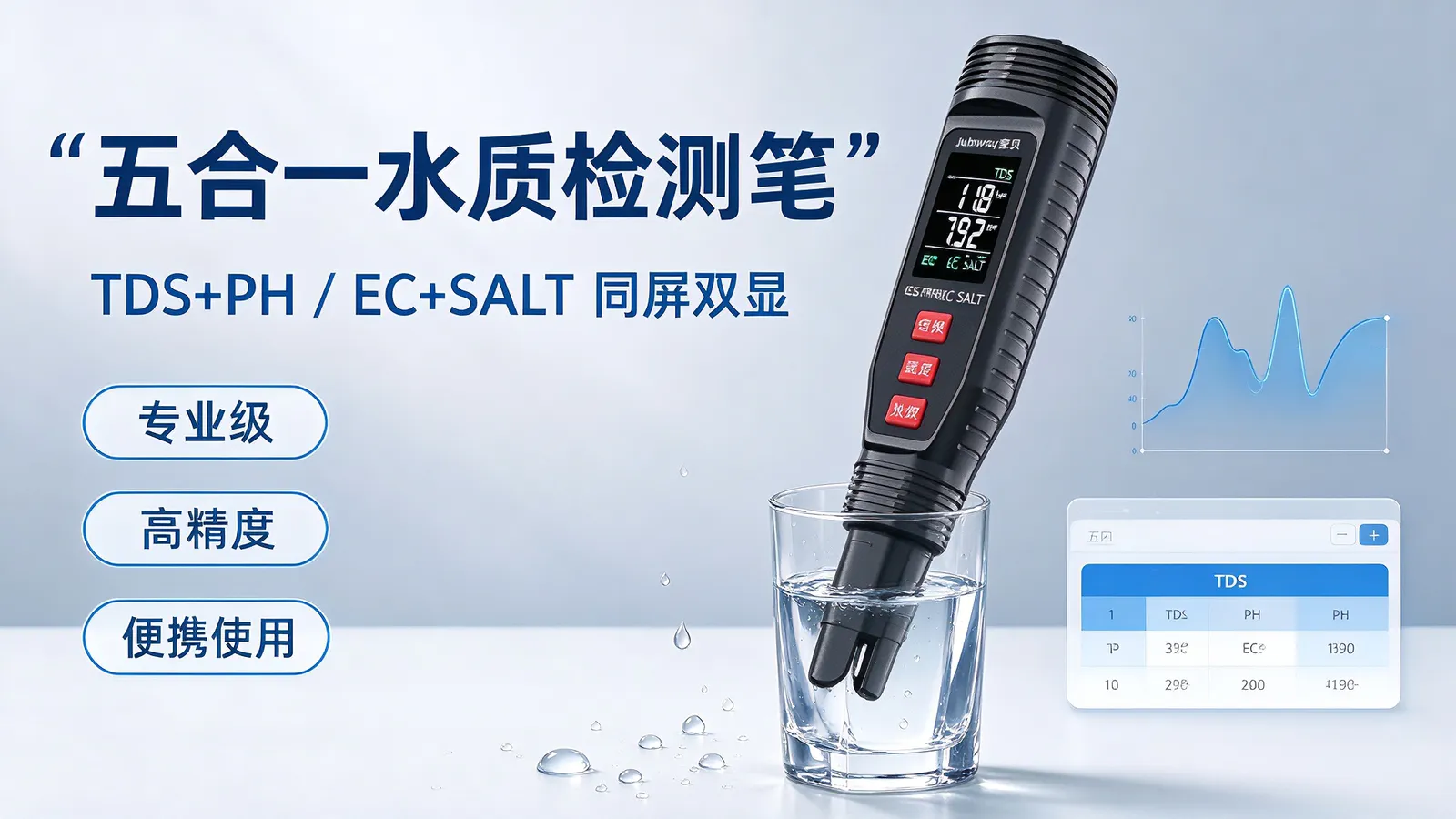
I. What Is pH? Why Do We Measure pH?
pH represents the acidity or alkalinity of a solution and essentially measures the activity of hydrogen ions (H⁺) in the solution.
• pH < 7: acidic, more hydrogen ions
• pH = 7: neutral
• pH > 7: alkaline, more hydroxide ions
Whether it is tap water, wastewater, aquaculture water, chemical liquid, or swimming pool water, pH is a mandatory indicator. It directly affects water quality safety, the effectiveness of water treatment chemicals, microbial survival, and equipment corrosion. The pH meter itself is only a signal conversion instrument; the core component that truly senses acidity and alkalinity is the pH electrode Emerson.
Many people easily confuse the two: a pH meter ≠ a pH electrode. The pH electrode is the probe responsible for sensing the signal; the pH host is only responsible for reading the voltage and converting it into a pH number.
II. Internal Structure of a Composite pH Electrode
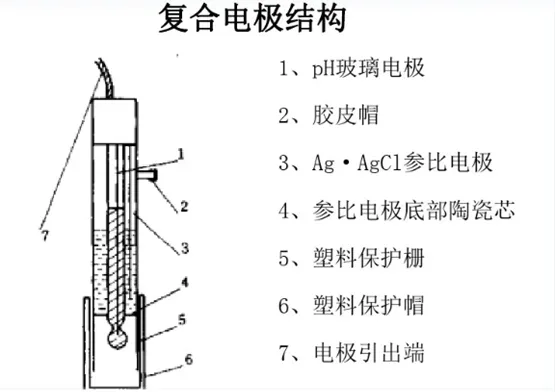
The mainstream products used in the industry today are composite pH electrodes, which integrate the measuring electrode (glass electrode) and the reference electrode into a single probe. They mainly consist of four core parts:
1. Sensitive glass bulb (core of the measuring electrode): a thin special glass membrane at the very front of the electrode that responds only to hydrogen ions and is the "sensing window" of pH perception;
2. Internal reference system + internal buffer solution: a buffer solution with a fixed pH and a silver-silver chloride internal reference wire are sealed inside the glass bulb;
3. External reference system, KCl electrolyte: provides a stable and unchanging reference potential;
4. Liquid junction (diaphragm / sand core): the reference electrolyte slowly seeps out, connects with the water sample to be measured, forms a complete electrochemical circuit, and at the same time blocks a large amount of water sample from seeping in and contaminating the interior of the electrode.
III. pH Electrode Detection Principle: Converting Potential Difference into pH Value
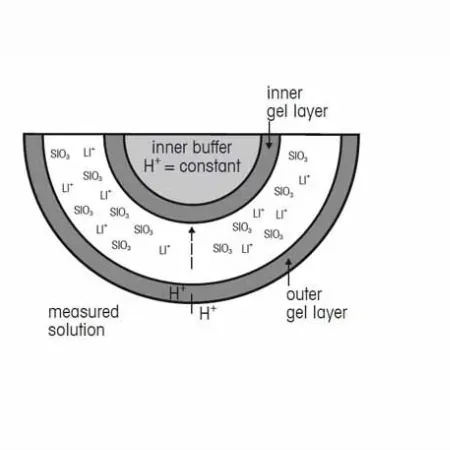
The underlying principle of the pH electrode belongs to potentiometric analysis and follows the Nernst equation. We will first explain the plain version, then add a professional explanation later.
When we immerse the pH electrode in the water to be measured:
1. After the sensitive glass of the glass bulb contacts the aqueous solution, the glass surface hydrates and forms a very thin hydrated gel layer;
2. Hydrogen ions in the water sample undergo ion exchange with sodium ions in the gel layer. The higher the hydrogen ion concentration in the water sample, the stronger the exchange reaction, and the charge on the outer side of the glass membrane changes;
3. Inside the glass membrane is an internal filling solution with a fixed pH, and the internal potential remains stable; different hydrogen ion concentrations on the inner and outer sides produce a potential difference (mV voltage signal);
4. The reference electrode continuously outputs a stable and unchanging reference potential; the instrument reads the difference between [measuring electrode potential − reference electrode potential];
5. This voltage difference has a stable linear relationship with the pH value of the water sample, and the instrument directly outputs the pH reading through conversion.
A simple analogy:
The glass membrane is like a sensing membrane that only allows hydrogen ions to "check in and exchange." The reference electrode is equivalent to a fixed ruler. The glass membrane generates different voltages according to how many hydrogen ions are in the water. Comparing the voltage level with this fixed ruler allows the acidity and alkalinity to be calculated.
Professional supplement: the Nernst equation
Under normal temperature conditions of 25°C, the relationship between potential and pH is simplified as:
E = E₀ − 0.0592 × pH
E: electrode output potential; E₀: constant; 0.0592V is the voltage change corresponding to every 1 unit change in pH at 25°C.
Key point: this coefficient is strongly related to temperature. When temperature changes, the mV voltage corresponding to the same pH also changes.
This is why most industrial pH electrodes have automatic temperature compensation (ATC). The temperature compensation module is used to correct measurement deviations caused by temperature and ensure accurate readings at different water temperatures.
IV. Why Must pH Electrodes Be Calibrated?
Many users ask: if the electrode principle is fixed, why must it be calibrated with standard buffer solutions before each water measurement?
1. The sensitive glass membrane ages, and its hydration state changes slowly; the E₀ constant slowly drifts with the electrode's service time;
2. The liquid junction is easily blocked by impurities, suspended solids, and sludge in the water, causing potential shift;
3. Each electrode has individual differences in factory parameters.
The essence of calibration: use standard buffer solutions with known pH (pH 4.00, pH 6.86, pH 9.18) to establish a "voltage-pH" correspondence curve for the instrument, eliminate electrode drift errors, and ensure accurate test results.
V. Common Application Scenarios of pH Electrodes
pH electrodes are widely used in various water quality testing equipment:
✅ Online monitoring of municipal wastewater, surface water, and drinking water
✅ Water quality testing for aquaculture, landscape water, and swimming pools
✅ Acidity and alkalinity control of chemical production liquids and electroplating wastewater
✅ Laboratory physical and chemical testing, supporting water treatment equipment
✅ Portable water quality testing toolboxes, online pH monitors
VI. Extended Knowledge: Factors Affecting the Measurement Stability of pH Electrodes
1. Temperature: without temperature compensation, the greater the temperature difference, the greater the error;
2. Water sample impurities: high turbidity, oil stains, and heavy metals easily adhere to the glass bulb and reduce response speed;
3. Soaking and maintenance: glass electrodes cannot be left dry for long periods and need to be soaked in storage solution to maintain the hydrated gel layer; if left dry for too long, electrode sensitivity decreases or even fails;
4. Liquid junction blockage: KCl electrolyte cannot permeate normally, the circuit is disconnected, and readings drift or jump.
VII. Summary
A pH electrode does not directly "capture" numbers. Instead, it relies on a special glass membrane to undergo ion exchange with hydrogen ions, generate a millivolt potential signal corresponding to acidity and alkalinity, then compare it with the reference potential of the reference electrode, and convert it according to the Nernst relationship to obtain the pH value.
To achieve long-term stable pH testing of water quality, in addition to understanding the principle, standardized calibration, daily maintenance, and reasonable model selection are equally important.
We provide various pH electrodes for water quality testing, portable pH test pens, and water quality testing toolboxes, suitable for laboratory testing, on-site rapid testing, online monitoring, and other scenarios. Customized selection is supported. Welcome to inquire.