
1. First: how does a pH meter actually get a pH reading?
Many people think the number on the screen is the solution’s acidity measured directly. It isn’t.
The core is a combination glass electrode. When you dip it into a solution, hydrogen ions across the glass membrane create a small potential difference (in millivolts, mV). That potential relates to hydrogen-ion activity via the Nernst equation:
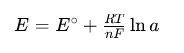
Parameter notes
- E: electrode potential (V)
- \(E^\circ\): standard electrode potential (V)
- R: gas constant, 8.314 J/(mol・K)
- T: thermodynamic temperature, \(T=273.15 + t(℃)\)
- n: number of electrons transferred; for \(\boldsymbol{H^+}\), \(\boldsymbol{n=1}\)
- F: Faraday constant, 96485 C/mol
- a: ion activity (not simple concentration; in dilute solutions ≈ concentration)
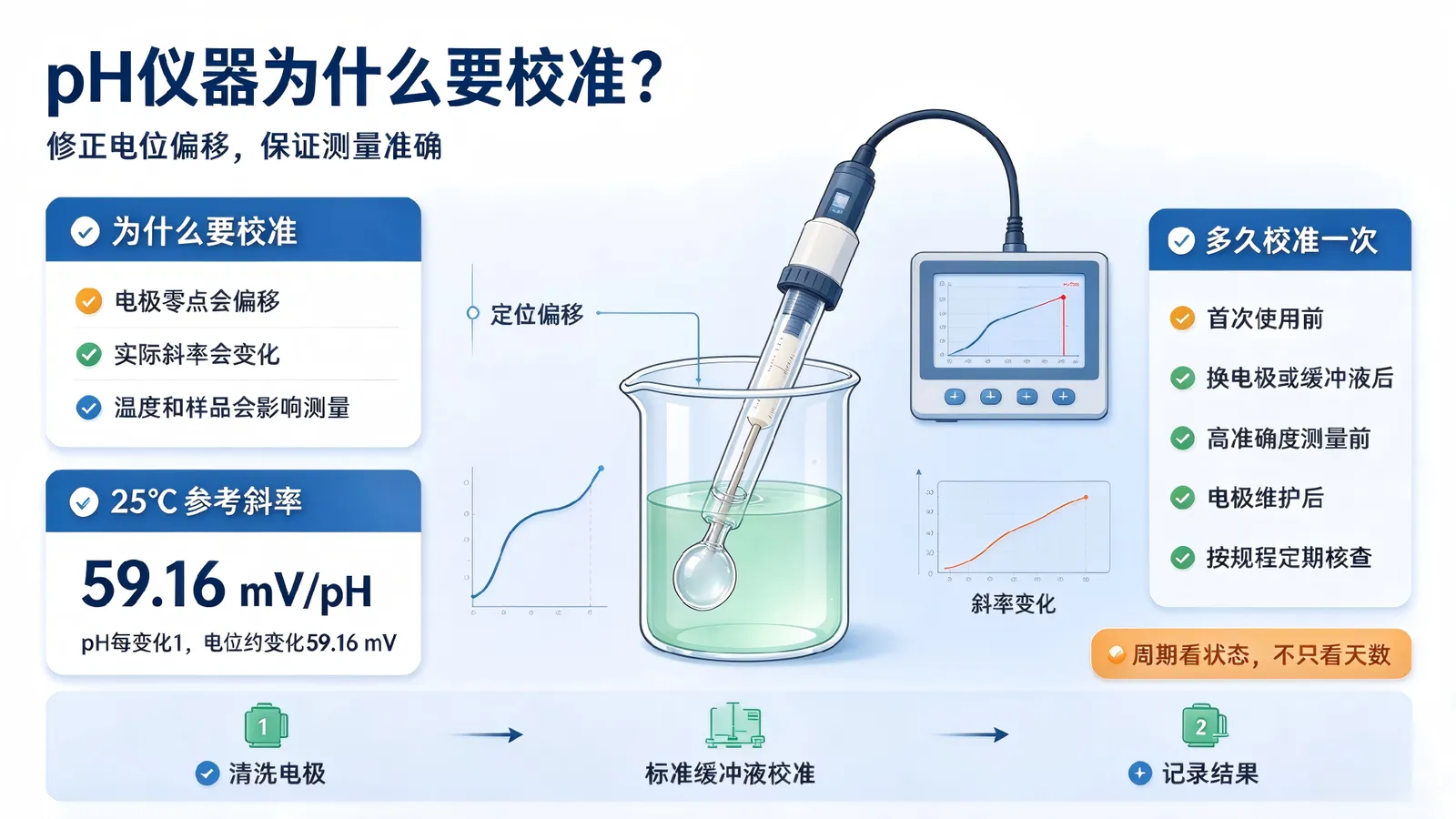
At 25℃ , in theory each 1 pH unit corresponds to 59.16 mV. Inside the meter, a high-impedance voltmeter reads that millivolt signal, then a conversion formula turns mV into the pH shown on screen.
The catch: the textbook formula is perfect; real electrodes aren’t — and they change with time, temperature, and use. That’s the fundamental reason calibration is required.
2. Why must pH instruments be calibrated? Six scientific reasons
Reason 1: Glass electrodes have an “asymmetry potential”
In theory, a brand-new ideal glass electrode in pH 7.00 buffer should output 0 mV. In reality, the inner/outer glass membrane isn’t perfectly symmetric, and manufacturing varies — almost every electrode shows a non-zero mV at pH 7. That’s the asymmetry potential (zero offset).
The offset varies by electrode and aging — from a few mV to tens of mV. Calibrating with pH 7 buffer “locates” the zero so the meter stores and subtracts that offset when measuring samples.
Reason 2: Electrode slope declines with aging — it never stays at the ideal 59.16 mV/pH
59.16 mV/pH from the Nernst equation is the theoretical maximum. A new electrode may reach 95%–100%, but with use, membrane aging, and junction clogging, the real slope falls. A one-year-old electrode may be only 45 mV/pH or lower.
What does that mean? If the meter still converts with 59.16 mV/pH, the same 50 mV difference might read 0.85 pH on a new electrode but only 0.65 pH on an old one — error appears immediately.
Two-point calibration (pH 7 + pH 4 or pH 9) measures the electrode’s actual slope and actual zero, replacing textbook theory with real parameters.
Reason 3: Temperature changes both slope and the buffer’s own pH
The Nernst equation includes temperature T; about 0.2 mV/pH per 1℃. Worse, buffer pH itself shifts with temperature — e.g. a nominal pH 6.86 buffer is about 6.98 at 0℃ and 6.84 at 60℃.
Without automatic temperature compensation (ATC), or if calibration and sample temperatures differ, a 10℃ gap can cause about 0.3 pH error. Calibration also checks that temperature compensation is working.
Reason 4: Reference-electrode junction potential drifts
A pH circuit has an indicating electrode (glass) and a reference electrode. The reference contacts the sample through a porous junction, which creates a liquid-junction potential.
After dirty water, wastewater, or protein samples, the junction can clog or foul; the junction potential drifts unpredictably. Regular buffer calibration is how you detect and correct it.
Reason 5: Sample matrix effects “pull” the electrode off
Oils, heavy metals, surfactants, or high-viscosity samples can foul or poison the glass surface — slower response, lower slope. After a batch, the electrode may no longer match its last calibration state.
China’s environmental standard HJ 1147-2020 requires: calibrate before each batch; recalibrate when sample pH varies widely or the monitoring site changes.
Reason 6: Electronics drift too
Input amplifiers and A/D converters drift slightly with time, supply voltage, and humidity. Usually small, but not negligible at ±0.01 pH. Calibration also corrects the instrument’s electronic zero.
3. How often to calibrate? By scenario
There is no single “universal interval.” Frequency depends on accuracy needs and environment. Summary based on metrology rules, major vendors (Mettler Toledo, Metrohm, YSI, etc.), and field practice:
| Scenario | Suggested frequency | Basis |
| High-precision R&D / pharma QC (±0.01–0.02 pH) | Calibrate before every measurement; verify with a third buffer | GMP expectations, Metrohm guidance |
| Routine lab / water testing (±0.05 pH) | Once per day before sampling | JJG 119-2018 in-use checks |
| Online continuous / large batches | Every ~10 samples or every 4–8 hours | Industry practice |
| Teaching / general field (±0.1 pH) | 1–2× per week, or before each experiment | Metrohm daily-use guidance |
| Occasional use (a few times/month) | Calibrate before each use | Apera manuals |
| After long storage | Must recalibrate; preferably reactivate the electrode first | All vendor manuals |
| After cleaning / regeneration / membrane change | Must recalibrate | Mettler Toledo maintenance practice |
| Mandatory metrology verification | Once per year by an accredited metrology body | JJG 119-2018 Laboratory pH (acidity) meters |
Recalibrate immediately if:
- Sample temperature differs from calibration temperature by more than 5℃
- You just measured strong acid (pH<2) or strong base (pH>12)
- The electrode was taken from storage solution and used directly
- You suspect contamination or “poisoning”
- Readings look suspicious vs expected trends
- You installed a new electrode
4. Standard calibration SOP
Step 1: Choose the right buffers
Usual practice is two-point calibration:
- First point: pH 6.86 (or 7.00) for locating/zero — the neutral reference
- Second point by sample acidity/alkalinity:
- Acidic samples → pH 4.00
- Alkaline samples → pH 9.18 (or 10.01)
- For a wide range (strong acid and base) or very high precision, use three-point calibration (pH 4.00 + 6.86 + 9.18) to correct nonlinearity at extremes.
Step 2: Preparation
- Buffers and samples should be at the same temperature (ΔT ≤ 2℃)
- Rinse the electrode with pure water; blot gently with filter paper (do not wipe the glass membrane — static interference)
- Pour buffer into a beaker; don’t dip into the stock bottle
- Discard used buffer — don’t pour back
Step 3: Perform calibration
- Place electrode in pH 6.86 buffer, stir gently, wait for a stable reading (usually 30 s–2 min)
- Confirm locating/zero
- Rinse; place in second buffer (pH 4.00 or 9.18)
- Wait for stability; confirm slope
- The meter shows slope %: normal is about 95%–105%; below 90% means aging — clean or replace
Step 4: Verify
After calibration, check with a third buffer (not the two used for calibration). If error is within tolerance, calibration is OK; otherwise recalibrate or inspect the electrode.
5. Eight common calibration mistakes
| Mistake | Consequence | Correct practice |
| Reuse buffers / pour back into the bottle | Contamination; buffer pH drifts | Use fresh portions; discard after use |
| Use expired buffers | Wrong pH — calibration itself is wrong | Opened bottles typically 2–3 months; discard if cloudy/moldy (per Chinese Pharmacopoeia pH method) |
| Large temperature gap vs samples | ATC ineffective; up to ~0.3 pH error | Keep ΔT within 2℃; enable ATC |
| Move electrode between buffers without rinsing | Cross-contamination; wrong slope | Rinse with pure water and blot between buffers |
| Wipe the glass membrane hard with filter paper | Static, drifting readings, membrane damage | Blot gently only |
| Store electrode dry | Membrane dehydrates; slope collapses | Store in 3 mol/L KCl storage solution — never dry |
| One-point only (pH 7 alone) | Zero corrected, slope not | At least two-point calibration |
| No verification buffer after calibration | Unknown whether calibration succeeded | Verify with a third buffer |
6. FAQ
Q1: Must I calibrate every time I power on? A: For high precision (±0.02 pH), calibrate before each measurement; for daily use (±0.1 pH), once per day at power-on is usually enough; for occasional use, calibrate before each use. The key isn’t “how often,” but “what error you can accept.”
Q2: Do pen-style pH meters need calibration too? A: Yes. Same glass-membrane potentiometry as benchtop meters. Uncalibrated cheap pens can be ±0.3–0.5 pH off — useless for quantitative work.
Q3: How long do opened buffers last? A: Chinese Pharmacopoeia typically allows 2–3 months if sealed and away from light. Discard if cloudy, moldy, or precipitating. Sachet/bulk buffers: preferably use within 1 month after opening.
Q4: How often to replace the electrode? A: Under normal use, combination glass electrodes often last 1–2 years. If slope stays below 90%, response is slow (>2 min), or readings keep drifting after locating, replace it.
Q5: Can pH test strips replace buffer calibration? A: No. Strips are only about ±0.5 pH — calibrating against them amplifies error. Use certified reference materials (e.g. GBW series) or metrology-recognized commercial buffers.
Q6: How do HJ 1147-2020 and JJG 119-2018 relate? A: JJG 119-2018 is the national metrology verification regulation (is the instrument accurate / due for lab check). HJ 1147-2020 is the ecology ministry’s water pH electrode method (how to calibrate and measure in the field). One covers compliance metrology; the other covers operating practice — follow both.
Q7: What’s the worst case of skipping calibration? A: Industry reports show uncalibrated meters can be off by ±0.5 pH or more. pH 6.5 vs 7.5 is “only” 1 unit, but H⁺ concentration differs 10× — affecting wastewater compliance, aquaculture safety, food QC, and more.
7. Bottom line
Remember: an uncalibrated pH meter is like a ruler whose scale keeps sliding — the number you get has limited value.
References: JJG 119-2018 Laboratory pH (acidity) meters; HJ 1147-2020 Water quality — Determination of pH — Electrode method; Chinese Pharmacopoeia general chapter 0631; technical docs from Mettler Toledo, Metrohm, Yokogawa, YSI, and others.