
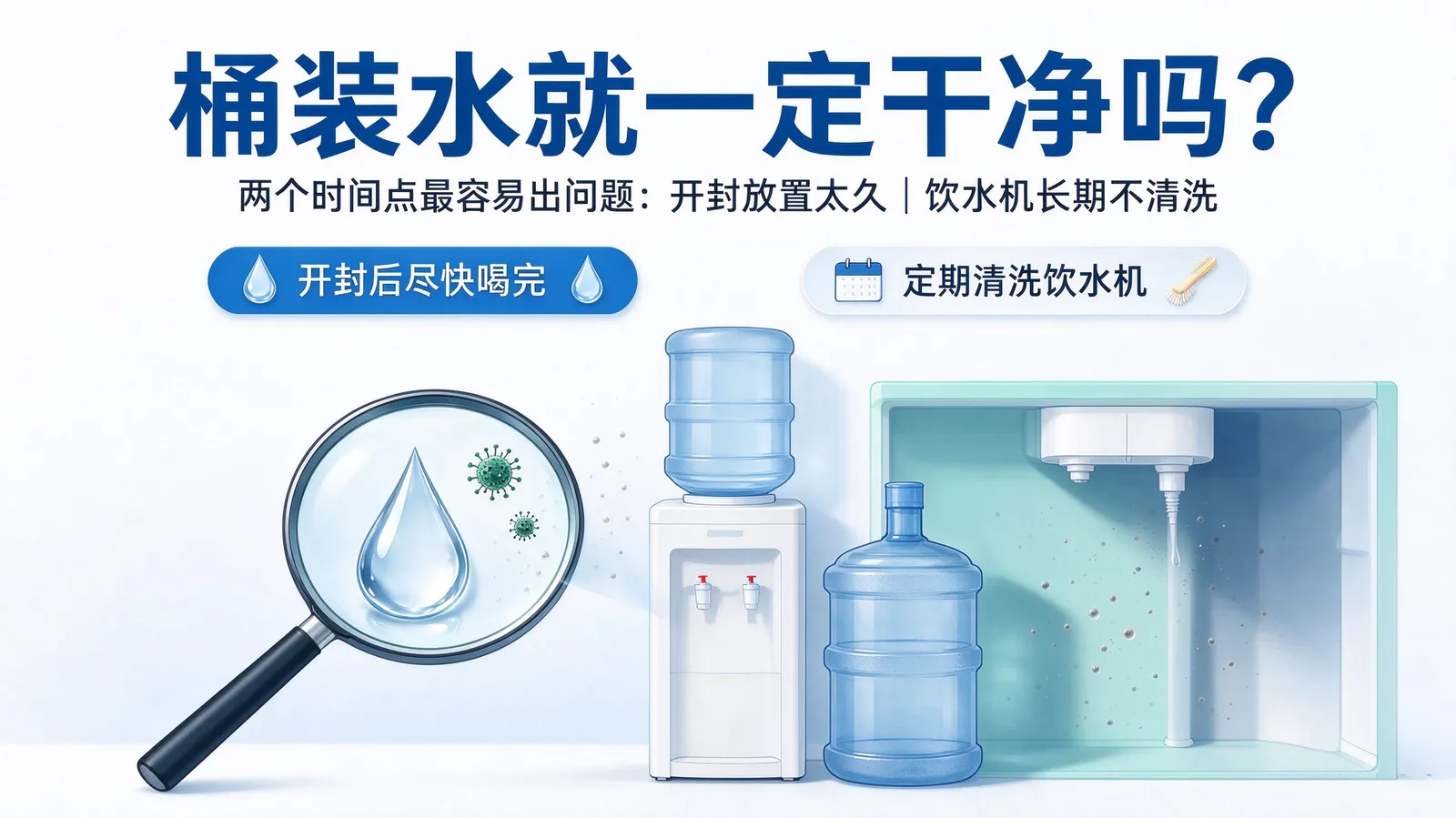
Graphic idea: Contamination risks of the bottled water itself plus the inner tank of the water dispenser, plus simple self-check methods.
Is the large bottled water you drink at home definitely cleaner than tap water?
Many households rely on five-gallon bottled water and assume it is sterile because it is factory-filled. This assumption is partially true but incomplete.
Large bottled water is clean when leaving the factory. However, once it is delivered to your home and installed on the water dispenser, contamination risks start to build up.
CCTV’s Life Tips program ran a test: bottled water opened for 3 days had a bacterial count of 146 CFU/mL, while tap water tested on the same day only had 4 CFU/mL. After just a few days of opening, the bacteria level in bottled water could be more than 30 times higher than tap water.
Where do these risks come from? Supported by test data and research, this article explains the two critical time windows when bottled water is most vulnerable to contamination.
1. Properly produced bottled water is safe while unopened
There is no need for unnecessary panic.
Sealed, qualified large bottled water from regular manufacturers meets safety standards before opening.
China’s Standards for Drinking Water Quality (GB 5749‑2006) sets clear microbiological limits: total colony count ≤100 CFU/mL, and coliform bacteria must not be detected. As long as the bottle cap remains intact and within the printed shelf life, the water inside is compliant.
The real risk appears after opening and during daily use. The moment you peel off the sealing film, air, dust and bacteria from the surrounding environment can enter the water.
2. The first risky window: Days 5 to 10 after opening
This is one of the highest-risk periods for opened bottled water.
A study conducted by Zhou Xiaohong from Haiyan Center for Disease Control and Prevention in Zhejiang Province, published in the Chinese Journal of Health Laboratory Technology, found that:
- Days 1–3 after opening: all microbiological indicators stayed qualified
- Day 5: qualification rate dropped sharply to only 60%
- Day 7: qualification rate fell to 20%
- Day 10: total colony counts exceeded the standard in all tested samples
Bacteria and mold from ambient air keep entering and multiplying in the open water. Higher room temperature speeds up reproduction, especially in summer. Health experts generally recommend finishing an opened bottle within 7 days; in hot weather, limit consumption to 3–4 days.
Key takeaway: Day 5 is a turning point. Risks rise significantly between Day 7 and Day 10.
3. The second risky window: When the water dispenser is left uncleaned for a long time
Most people replace the bottled water regularly but forget about the dispenser itself. In fact, the inner tank and cold water outlet of the dispenser are often bigger pollution sources.
Test results show the dispenser tank is prone to bacterial buildup. The Bor Luh Food Safety Center of Shanghai Jiao Tong University tested water from 5 dispensers, with colony counts ranging from less than 1 CFU/mL up to 1600 CFU/mL. The hygiene condition of the dispenser directly decides whether your drinking water is safe.
A survey from Shenyang CDC is even more revealing: 16 dispensers from 8 offices and 5 households in Beijing were sampled. Only 2 office dispensers met the standard. The most heavily contaminated sample had bacteria levels 190 times higher than tap water.
If a dispenser is not cleaned regularly, slime and biofilm form on the inner tank, bottle seat and cold water pipe walls, creating an invisible breeding ground for bacteria. Every cup of water you pour flows through this contaminated layer.
4. Two easy self-checks you can do at home
No professional equipment required. Try these simple checks:
- Inspect the bottle seat (smart seat). This is the connector between the bottle and dispenser. Yellowing, black stains or a slippery slimy surface mean contamination has already occurred.
- Smell and observe the water. Odd odors, cloudiness, floccules, green algae or slippery texture after standing all signal possible water quality issues.
For quantitative testing, you can use a TDS & pH test pen to measure total dissolved solids and pH value, or water test kits to check bacteria, residual chlorine and other indicators. Self-testing cannot replace official laboratory testing, but it helps you spot risks early.
5. Hot water is safer — but it is not a complete solution
Good news: Most bacteria die rapidly above 80°C. The hot water outlet of most dispensers runs at 85–95°C, so hot water carries lower risk than cold water.
However, heat cannot solve all problems. Once thick biofilm builds up inside an uncleaned dispenser, hot water cannot fully eliminate it. Many people drink cold water directly, which greatly increases exposure risk.
Practical advice: Try to drink hot water after the bottle has been open for 3 days. Finish each bottle within 7 days. Clean and disinfect the water dispenser at least once per month.
Final thoughts: Do not judge water safety by feeling alone
Back to the original question: Is bottled water always clean?
Safety depends on two factors: how long it has been open, and how recently the dispenser was cleaned.
Quick reference rules:
- Boil or use hot water for bottles opened longer than 7 days
- Clean the dispenser immediately if the bottle seat is dirty or the water smells strange
- Shorten the drinking cycle during hot summer months
- Extra caution for families with elderly people, children or immunocompromised members
To turn invisible water risks into readable data, test your water when replacing bottles with a TDS & pH test pen or water test kits. Regular self-inspection, frequent dispenser cleaning and timely water replacement are the most reliable ways to stay safe.