
"Doesn't boiling make tap water safe?" It is the default answer in most households. But once you notice limescale buildup, yellowish tap water, or that faint chlorine smell that never seems to go away, you start to wonder: is boiling really doing the whole job? This plain-language guide answers three questions at once: how safe is tap water, what boiling can and cannot do, and whether a home purifier is a scam or a necessity.
In this article
- How clean is tap water when it leaves the plant?
- What does boiling actually kill?
- The 7 things boiling cannot fix
- The ignored "last mile": secondary contamination
- What do water purifiers actually filter?
- Do you need one? Match your situation
- A purifier is not "set and forget"
- FAQ
1. How clean is tap water when it leaves the plant?
First the good news: tap water leaving a properly run municipal plant meets national standards.
In China the current mandatory standard is GB 5749-2022 "Standards for Drinking Water Quality", effective April 1, 2023. It covers 97 indicators (43 routine + 54 expanded) and adds four newer contaminants of concern: perchlorate, acetochlor, 2-methylisoborneol (MIB) and geosmin (the last two cause earthy/musty taste).
The standard demands that drinking water be free of pathogenic microbes, free of harmful chemicals and radioactivity, taste and look acceptable, and be disinfected.
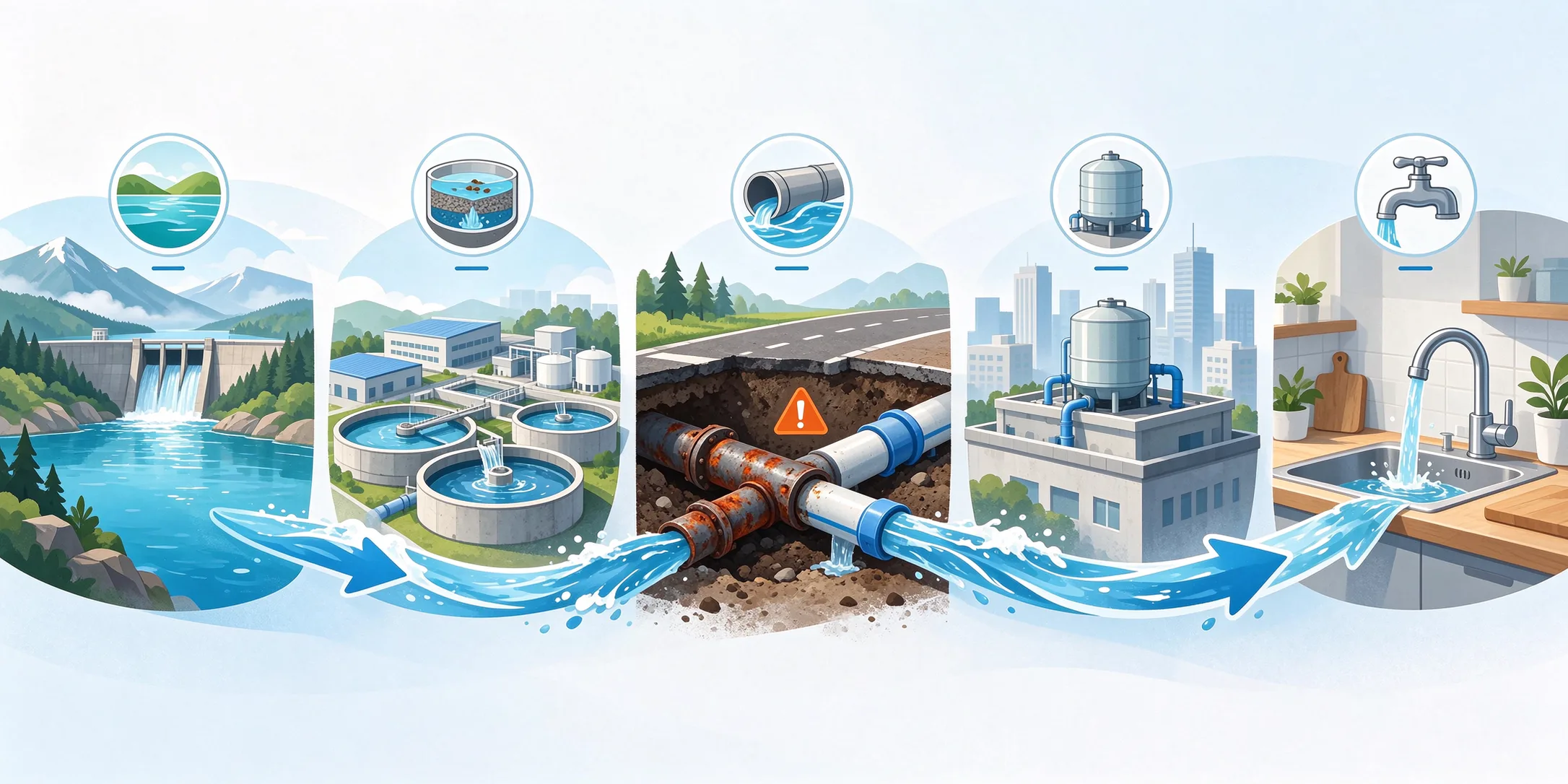
So the water at the plant outlet is tightly regulated. The question is what happens to it on the way to your cup — through kilometers of pipes,小区 water tanks, and household fittings. The national standard cannot control every meter of that journey.
2. What does boiling actually kill?
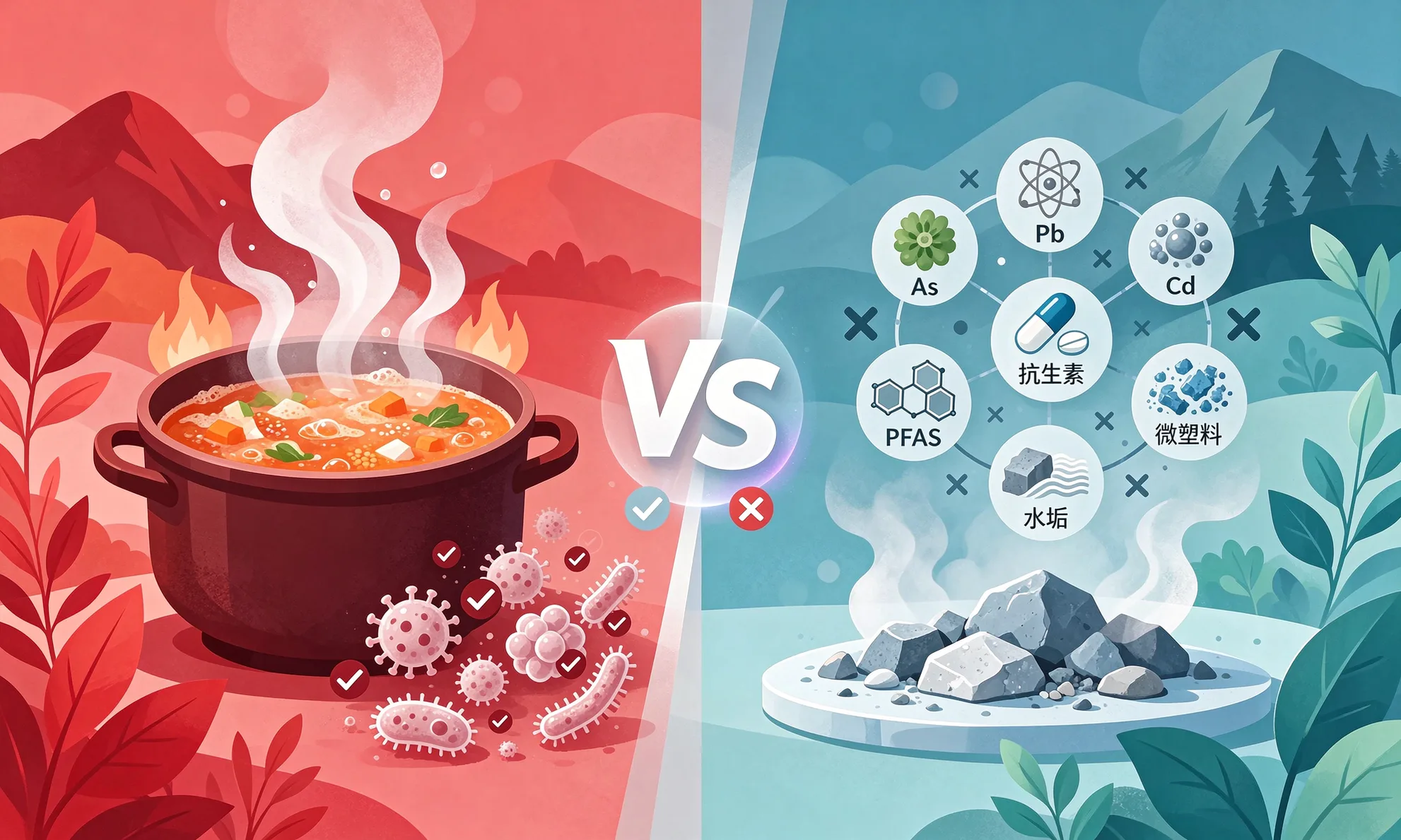
Boiling is a centuries-old trick, and it really works — but only against one class of threat: living microbes.
Rolling boil for one minute (three minutes above 2,000 m) inactivates essentially all bacteria, viruses, Giardia and Cryptosporidium. It is also the WHO's go-to emergency treatment after disasters.
Boiling also drives off some volatile organic compounds. Studies show trihalomethanes (THMs) and haloacetonitriles drop by 60% or more once water reaches a rolling boil — that "chlorine smell fading away" is real.
| Boiling handles | Boiling cannot handle |
|---|---|
| BacteriaVirusesParasitesFree chlorineVolatile disinfection by-products | Heavy metalsNitratePFASAntibioticsMicroplasticsLimescaleChloramine |
3. The 7 things boiling cannot fix
1. Heavy metals: lead, arsenic, cadmium, mercury, hexavalent chromium
Metals are elements — boiling does not destroy them. Worse, as water evaporates, the same amount of metal is left in less water, so concentration per glass actually rises. Old galvanized pipes, solder joints and low-quality brass faucets can leach lead. Regulators in the US and EU repeat the same line: if lead is suspected, do not rely on boiling — test, then filter or switch source.
2. Nitrate
Common in agricultural runoff and some well water. Boiling concentrates it. China's limit is 10 mg/L (as N); infants are especially vulnerable to methemoglobinemia ("blue baby syndrome").
3. Haloacetic acids (HAAs)
Unlike volatile THMs, HAAs barely evaporate at 100°C. Long-term exposure is associated with elevated bladder and colorectal cancer risk.
4. PFAS — "forever chemicals"
Per- and polyfluoroalkyl substances have extremely stable carbon-fluorine bonds. Boiling does not break them; the human body cannot metabolize them; their half-life in blood is on the order of years. China's GB 5749-2022 already added PFOA and PFOS to the expanded list at limits of 80 ng/L and 40 ng/L. Boiling does nothing for them.
5. Antibiotics and pharmaceutical residues
Trace residues from wastewater survive boiling. Long-term low-dose exposure is linked to gut microbiome disruption and antibiotic resistance.
6. Microplastics
Found in both bottled and tap water worldwide. Heating just fragments the particles; it does not remove them.
7. Chloramine, not free chlorine
An increasing number of cities switched from free chlorine to chloramine (chlorine + ammonia) so residual disinfectant lasts longer through the network. Free chlorine boils off; chloramine does not. This is why many people feel "boiled water still smells off these days." Activated carbon is what actually removes chloramine.
4. The ignored "last mile": secondary contamination
The national standard governs water leaving the plant. The water in your glass has traveled since then.
1. Aging distribution pipes
Roughly 30% of urban pipes in China have been in service for more than 20 years. Old galvanized steel and cast-iron pipes develop internal rust scale. First thing in the morning, or after a water shutoff, that yellow-brown flow is iron oxide being flushed loose.
2. Building water tanks: a blind box in high-rises
Above roughly six floors, water is typically pumped into a rooftop tank or underground cistern. If maintenance is infrequent, seals are broken, or vent screens are missing, algae, insects, E. coli and Legionella can grow inside. Surveys report E. coli exceedance rates above 15% in poorly maintained tanks. Boiling kills the microbes in the tank — but it cannot remove rust, sediment, dead algae, or whatever fell into the tank.
3. Inside your home: faucets, shower heads, water heaters
Aerators and shower heads that are never disassembled build up a slimy biofilm. Even good tap water passing through a biofilm layer gets re-contaminated.
"Plant water meets standard" ≠ "water in your cup meets standard." That gap is exactly what home filtration is designed to close.
5. What do water purifiers actually filter?
Home purifiers are graded by pore size — think of sieves with progressively smaller holes.
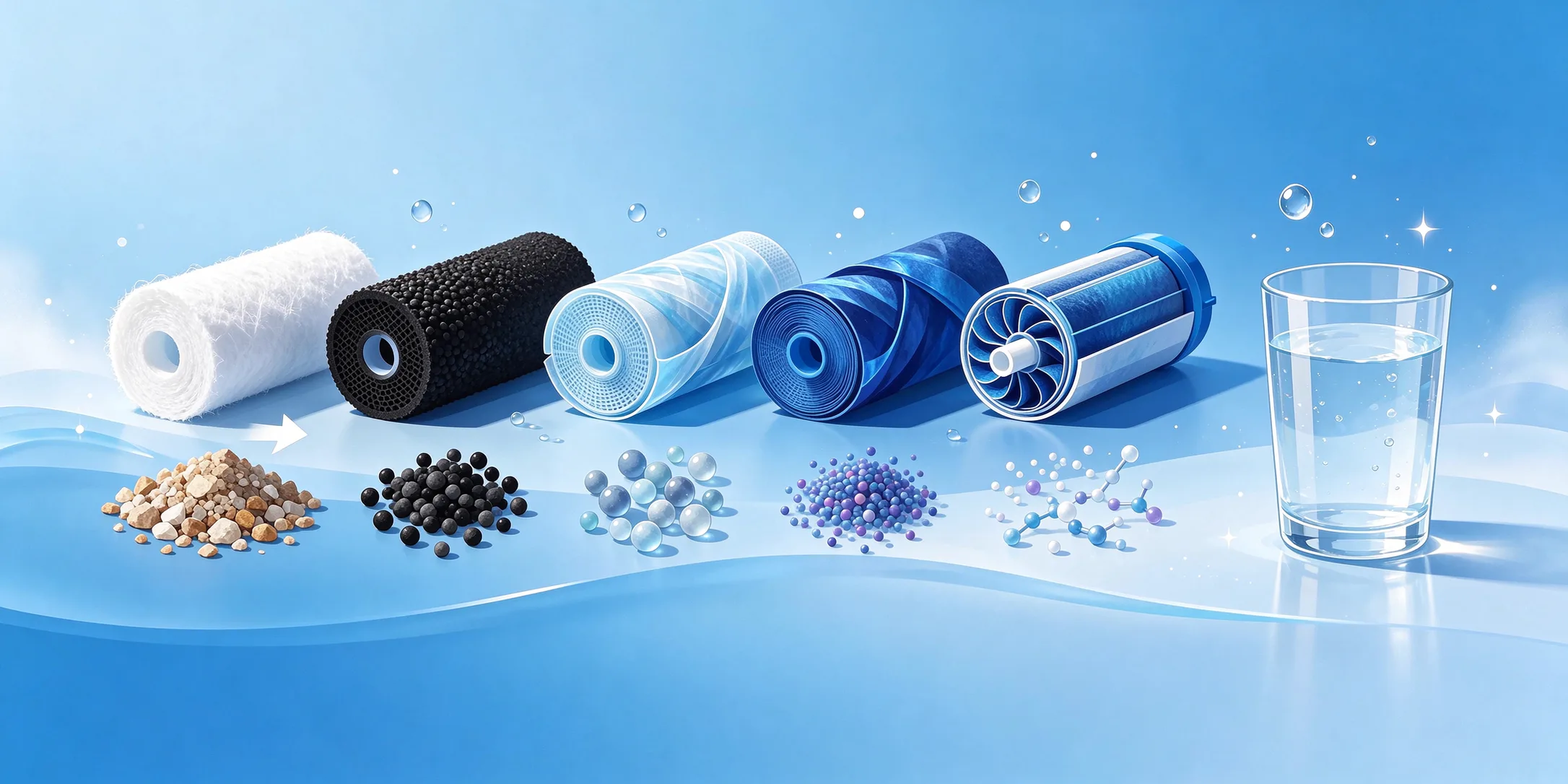
| Filter / type | Precision | Catches | Direct-drink? |
|---|---|---|---|
| PP sediment | ~5 µm | Rust, sand, large particles | No — pre-filter only |
| Activated carbon | Adsorption | Chlorine, taste/odor, some organics, pesticide residues | Not alone — usually paired |
| Ultrafiltration (UF) | 0.01 µm | Bacteria, colloids, large organics; retains minerals | Boil recommended; does not remove heavy metals or limescale |
| Nanofiltration (NF) | 0.001 µm | Most organics, many heavy metals, microbes; retains some calcium/magnesium | Yes — needs power, produces waste water |
| Reverse osmosis (RO) | 0.0001 µm | Nearly everything: heavy metals, bacteria, viruses, antibiotics, PFAS, microplastics | Yes — output is close to pure water |
To put the gap in perspective: a UF pore is roughly 100 times larger than an RO pore. A bacterium (about 1 µm) is stopped by UF. But a dissolved lead ion, an antibiotic molecule, or a PFAS molecule (0.001 µm and below) slips through UF like a mosquito through a wire fence.
6. Do you need one? Match your situation
| Your situation | Recommendation |
|---|---|
| New building, well-maintained pipes, no odor, no visible limescale | Not mandatory; a simple carbon tap filter for taste is enough |
| Old building (pre-2000), galvanized/cast-iron pipes, yellowish first-flush water | Strongly recommended: a pre-filter + endpoint purifier |
| High-rise with shared roof tank that is rarely cleaned, musty or fishy taste | Strongly recommended: RO + periodic water testing |
| Pregnant women, infants, elderly or immunocompromised members at home | RO — lower exposure to heavy metals and nitrates |
| Hard-water region (heavy white limescale on kettles) | RO (or NF) |
| Well water, spring water, private source | Test first (TDS, hardness, nitrate, microbes), then choose equipment |
| TDS meter consistently reads above 200 ppm, obvious scaling | RO recommended |
A very cheap diagnostic step: pick up a TDS meter (under US$20). It does not tell you which contaminants are present, but it tells you how much dissolved stuff is in the water. Municipal tap water usually runs 50–200 ppm. If you consistently see 300+ or a kettle that scales within weeks, an RO system is worth the investment.
7. A purifier is not "set and forget"
The biggest risk of a purifier is not buying the wrong one — it is forgetting to replace the filter.
- PP sediment: replace every 3–6 months
- Activated carbon: replace every 6–12 months
- UF / NF membrane: about 2 years
- RO membrane: 2–3 years (depends on inlet water quality and capacity)
An expired filter does not just stop working — the organic matter it has trapped, sitting wet, becomes a bacteria incubator. This is the origin of the horror story "my purifier made the water dirtier." Always choose products carrying the official China Drinking Water Hygiene Safety许可批件 (or NSF/ANSI 58 certification outside China) — that is the compliance floor.
FAQ
Q1: Does RO "pure water" leach minerals or cause deficiency?
No. More than 95% of daily calcium, magnesium and other trace elements come from food — vegetables, meat, eggs, dairy. Water contributes under 5%. You would need to drink tens of liters per day to get meaningful minerals from water.
Q2: RO machines waste a lot of water, right?
Modern machines with the highest efficiency tier reach a pure-to-waste ratio of 2:1 to 3:1. The concentrate stream can be captured for mopping, toilet flushing and plant watering.
Q3: Does a chlorine smell mean the water is toxic?
No. Residual chlorine is required by the standard to keep water safe through the network (0.3–2 mg/L at the tap is normal). It actually indicates disinfectant is still active. Carbon filters remove it effectively.
Q4: Is "boiled-then-cooled overnight water" carcinogenic?
No. Nitrite levels in repeatedly boiled tap water are far below national limits. The real concerns are chemical residues discussed above, not nitrite.
Q5: Isn't bottled water just as good?
Bottled water introduces its own issues: bottle-washing hygiene, secondary contamination inside the dispenser, and bacteria multiplying once the seal is broken. For a family, a RO point-of-use system is cheaper long-term and more controllable.
Closing thought
"Boiled tap water is already safe" — that statement is half true. It is safe from microbes; it is not safe from long-term chemical intake. It prevents acute illness; it does not prevent chronic exposure.
If you live in a well-maintained new building with good-tasting water, a kettle plus a TDS meter is enough. But if you are in an old building, drink from a rarely cleaned high-rise tank, scale your kettle within weeks, or have a pregnant mother or infant at home — a RO purifier is not consumerism. It is one of the cheapest health budgets a household can buy.
— Guangzhou Jiabei Water Treatment Co., Ltd. · Drinking-Water Science Series —
References: GB 5749-2022 "Standards for Drinking Water Quality" (China NHC/SAMR); Shanghai Administration for Market Regulation consumer guide on home water purifiers; People's Daily home-appliance buying guide for water purifiers; The Paper household water-safety guide; WHO Guidelines for Drinking-water Quality; Duke/NCSU research summaries on metals and boiling. This article is for education only and is not medical advice.