
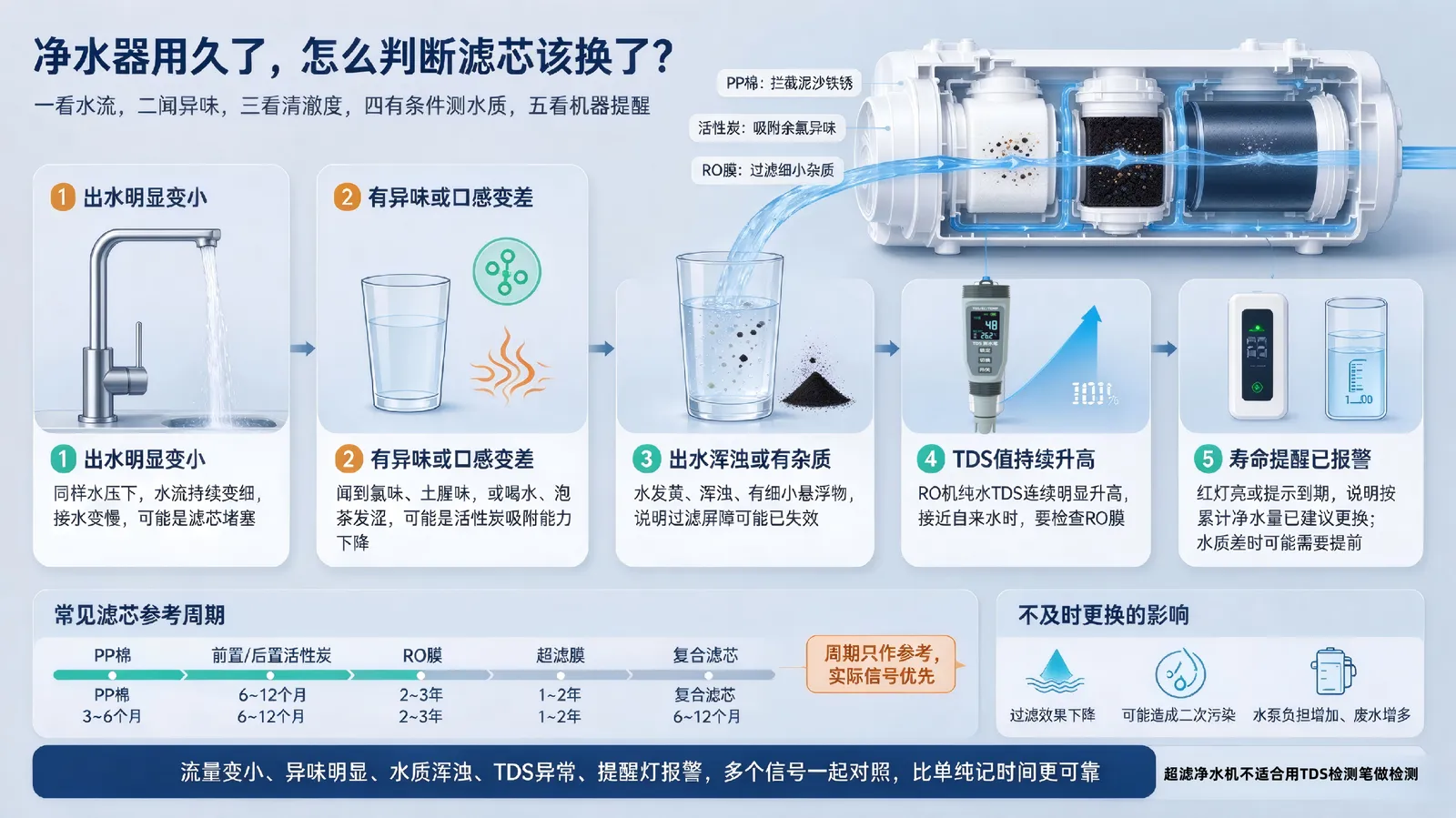
You should not rely only on the replacement schedule stated in the user manual. Tap water quality and daily water consumption vary from household to household. It is better to check with the simple methods below, which anyone can easily do at home.
1. Check the water flow: slow water output is an early warning
Compare the current flow with when the purifier was new. If the water comes out much slower under the same water pressure and it takes a long time to fill a cup, the filter is most likely clogged.
- The PP cotton filter usually gets clogged first, as it traps large particles such as sediment, rust and debris.
- If the water flow of an RO water purifier keeps dropping, the RO membrane may also be blocked.
Note: Water flow of RO machines naturally drops slightly in cold weather. First rule out low water pressure or unstable water supply after a water outage. If the flow stays weak for a long time, consider replacing the filter.
2. Smell and taste the water: strange odor usually means expired activated carbon
Properly purified water should be clean and odorless. If you can smell chlorine, earthy or musty odor from the purified water, or the water tastes bitter and astringent when drunk or used for tea, the activated carbon filter has reached its adsorption limit and can no longer remove residual chlorine and odors.
This problem is often most obvious with the first glass of water drawn in the morning, which deserves your attention.
3. Check water appearance: cloudy water or visible particles
Fill a cup with purified water and let it sit for observation. If the water turns cloudy or yellow, or you can see tiny suspended particles or black carbon powder (excluding black water after a new filter installation and flushing), the filter can no longer block contaminants. Replace it as soon as possible.
4. Test with a water quality tester (for RO reverse osmosis purifiers)
If you have a TDS meter, you can get an intuitive reference.
For RO purified water, the TDS reading should be much lower than that of raw tap water. If the TDS value of purified water keeps rising for several days and gets close to the tap water reading, the core RO membrane has lost its filtration capacity and needs inspection or replacement.
Tip: TDS meters are NOT suitable for judging ultrafiltration filters. Ultrafiltration retains minerals, so its TDS reading will not change much.
5. Check the built-in indicator light or water volume reminder
Most new water purifiers are equipped with filter life indicator lights and app alerts. A red light or a life-expired reminder is calculated based on total purified water output.
⚠️ Important: The reminder is only for reference! If the local water quality is poor with high sediment content, the filter may fail before the alert pops up. Do not wait for the warning light completely.
Reference replacement cycles for common filters (for reference only; prioritize actual signs)
- PP cotton (pre-filter): 3–6 months. Inspect every 3 months in areas with heavy sediment.
- Pre / post activated carbon: 6–12 months
- RO reverse osmosis membrane: 2–3 years
- Ultrafiltration membrane: 1–2 years
- Integrated composite filter: 6–12 months
Reminder: These cycles are just guidelines. If you notice strange odor, sharply reduced flow or poor water quality, replace the filter even before the scheduled time. A filter may look clean on the outside, while its inner pores are already full of pollutants.
Common misunderstandings
❌ Misunderstanding 1: The filter is fine if water still flows
A saturated and clogged filter can still drip water slowly, but its filtering ability drops greatly. You are essentially drinking poorly filtered water.
❌ Misunderstanding 2: Wash the filter and reuse it
PP cotton, activated carbon and RO membranes cannot be restored by washing. Rinsing only removes surface dirt. Contaminants trapped deep inside the pores cannot be washed away, and filtration performance will not recover.
❌ Misunderstanding 3: Safe as long as TDS reading is normal
TDS only measures total dissolved solids. It cannot detect odor, bacteria or residual chlorine. You need to judge from multiple signs together.
What happens if you delay filter replacement?
If the filter stays unchanged for too long, accumulated impurities and microorganisms will easily multiply and cause secondary pollution. Clogging also increases the load on the pump, leading to louder noise, more wastewater and a shorter service life of the whole machine. Your drinking water safety is at risk.
✅ Quick summary:
Check the water flow, smell for odd odors, watch for cloudiness, test water quality when available and pay attention to machine alerts. Cross-check these signals — this method is far more reliable than simply following a calendar. To protect your household drinking water, inspect your filters regularly. That’s the right way to use a water purifier.