
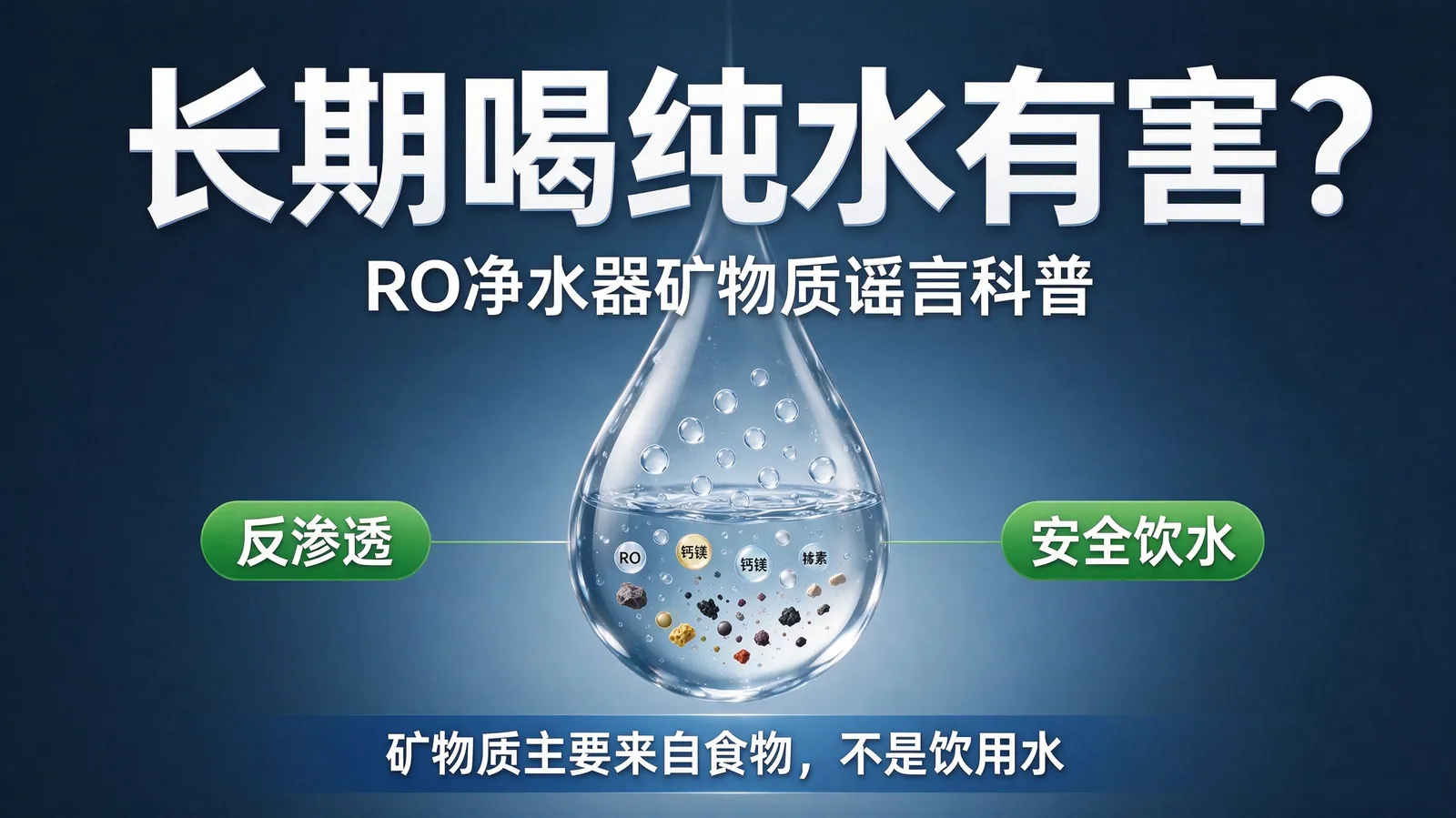
When buying a water purifier, you have probably heard this line: "Reverse osmosis is too clean. It strips away calcium, magnesium and potassium. Drinking pure water long-term causes calcium deficiency and osteoporosis—it's especially bad for children and the elderly."
Salespeople and short-video creators repeat this line to push "mineral-retaining" filters. It sounds convincing, but it is a long-circulating piece of pseudo-science. Let's break down the logic.
1. What does a Reverse Osmosis system actually filter?
1.1 How the RO membrane works
An RO membrane has pores as small as 0.0001 micrometres (0.1 nm). Water molecules are small enough to pass through; calcium and magnesium ions, heavy metals, bacteria, viruses and colloids are too large and are rejected to the concentrate side, then discharged as drain water.
- Permeate (pure water): mainly H₂O, with very low Total Dissolved Solids (typically 0–50 mg/L).
- Concentrate (drain water): carries the rejected calcium, magnesium, salts and contaminants away.
1.2 Common water-purifier types at a glance
| Technology | Removes heavy metals? | Minerals retained? | Best for |
|---|---|---|---|
| Reverse Osmosis (RO) | Yes (very high removal) | Almost fully removed | Direct drinking, uncertain water, old pipes, families with infants |
| Nanofiltration (NF) | Partial | Keeps monovalent ions, rejects divalent Ca/Mg | Between RO and UF |
| Ultrafiltration (UF) | No | Retained | Clean compliant water, low hardness, boiling before drinking |
| Carbon / PP sediment | No | Mostly unchanged | Chlorine, sediment, odor (pre-filter) |
2. The core question: do we get minerals from drinking water?
This is the key weak point of the myth. Calcium, magnesium, potassium and sodium come mainly from food, not water.
Let's run the numbers. Typical tap water TDS is about 200 mg/L, with roughly 30–50 mg/L of calcium. If you drink 2 L per day:
- Calcium from water ≈ 60–100 mg;
- Recommended daily calcium intake for adults ≈ 800–1000 mg.
Even drinking tap water every day, calcium from water accounts for less than 5–10% of the daily need. The other 90%+ comes from dairy, soy products, leafy greens, fish and meat. The contribution of magnesium in water is even smaller.
3. Two side-myths, debunked
Myth A: Pure water is "acidic" and acidifies your body
The truth:
① Pure water is pH-neutral at first; after absorbing CO₂ from air, it drops to pH 5.5–6.5 (mildly acidic).
② The human body has powerful acid-base buffers (bicarbonate in blood, lungs, kidneys). Slightly acidic water cannot change blood pH.
③ The "acidic body" concept has long been rejected by mainstream medicine.
Myth B: Pure water "pulls minerals out of your body" because of osmosis
The truth: osmosis only happens across a semipermeable membrane. The digestive tract is not a simple semipermeable membrane. Once water enters the stomach and intestines, it immediately mixes with gastric and intestinal fluids and becomes an electrolyte-rich body fluid—no longer hypotonic pure water. There is no "mineral-sucking" effect. This misapplies lab membrane theory to human digestion.
4. What do the standards say?
Many people assume national standards require minerals in water. They do not:
- GB 5749-2022 Standards for Drinking Water Quality — sets pollutant limits. It does not mandate "beneficial minerals" such as calcium and magnesium, and sets no lower TDS floor. The standard governs water safety, not water nutrition.
- GB 17323 Bottled Purified Water — specifically covers bottled purified water (essentially RO water). Purified water is recognized as a drinking water category. Bottled purified water has been sold for decades; if long-term RO water were harmful, the standard would not allow it at scale.
- WHO WHO review on minerals in drinking-water — states that, with an adequate diet, drinking low-mineral water does not cause health risks. Risks are limited to special situations: extremely monotonous diets, water-scarce regions, and infant formula preparation—not ordinary daily drinking.
5. Cases worth paying attention to (reasonable, not fear-mongering)
We do not swing to the opposite extreme. Here are scenarios that genuinely deserve attention:
| Group / scenario | Reasonable advice |
|---|---|
| Infant formula | Formula already contains precisely balanced calcium, magnesium and electrolytes. RO water is acceptable for mixing; follow the label and pediatric advice if complementary foods are limited. |
| Heavy sweating / heat work | RO water is fine for hydration, but prolonged heavy sweating requires extra electrolytes (dilute salt water or sports drinks). The issue is sweat loss, not pure water itself. |
| Extremely monotonous diet | Where food lacks dairy and vegetables, trace minerals in water matter a little. Most urban residents with varied meals are not in this situation. |
6. RO vs mineral-retaining filters: how to choose?
This is not an ad for RO—it is a plea to stop using the wrong reason ("pure water is harmful") to choose. The real criterion is your source water quality, not "whether minerals are retained":
For safety, look at contaminants; for nutrition, look at meals. Water is for hydration and safety.
7. FAQ
Q1: Does long-term RO water cause calcium deficiency or osteoporosis?
No, on a normal diet. Over 90% of calcium comes from food. Osteoporosis is linked to low calcium intake, vitamin D deficiency, inactivity and hormones—not to drinking pure water.
Q2: Is RO water the same as bottled purified water?
Yes, by principle. Quality RO permeate meets the logic of bottled purified water standards such as GB 17323.
Q3: Is pure water "dead water" because it lacks minerals?
Water is a solvent and participates in metabolism; it is not a nutritional food. "Dead water" is a marketing term with no scientific definition.
Q4: Is lower TDS always better?
No. TDS measures total dissolved solids; it is a reference, not the sole quality criterion. Heavy-metal-contaminated water can still show a low TDS reading.
8. Takeaway
- RO does remove most calcium, magnesium and potassium from water—that is a fact;
- Over 90% of the body's minerals come from meals, dairy, eggs, fruit and vegetables; water contributes negligibly;
- "Long-term pure water is harmful" is a forced link between "minerals removed" and "health damage", amplified and taken out of context;
- National standards (e.g. GB 17323) recognize purified water; on a normal diet, long-term RO water poses no health risk;
- Choose a purifier based on local source-water safety and your drinking habits—not on "mineral marketing" fear-talk.