
How to Choose, Combine and Run Pond Aerators:
A Practical Guide to Power-Outage and Oxygen Emergency
01Why Dissolved Oxygen Is the Lifeline of Every Pond
Fish, shrimp and crabs breathe 24 hours a day. So do algae, uneaten feed, bottom sludge and bacteria. In a typical 5-mu (≈0.8 ha) grow-out pond at 1.5 m depth, the nighttime oxygen demand from waste and microbes can exceed the oxygen consumed by the fish themselves.
Every pond follows a predictable daily dissolved oxygen (DO) cycle:
- Daytime: algae photosynthesize; surface DO peaks between 2 and 4 p.m., often supersaturated (10 mg/L or higher).
- Nighttime: photosynthesis stops, the whole pond only consumes oxygen. DO declines steadily.
- Pre-dawn (3–6 a.m.): the lowest DO point of the day — and the highest risk of surfacing, gasping and total die-off.
On top of this, hot weather creates a thermocline: warm surface water floats on cold bottom water with almost no mixing. The result is a paradox — surface water is supersaturated while the bottom is already anoxic. A sudden thunderstorm or strong wind can break the thermocline in minutes; the oxygen-rich surface layer mixes with the oxygen-starved bottom, and the whole pond crashes. This is what farmers call a "pond turnover" or "fish kill."
| DO Level | Value | What It Means |
|---|---|---|
| Safe | ≥ 5 mg/L | Target for routine fish and shrimp culture |
| Warning | 3 mg/L | Trigger emergency response immediately |
| Danger | < 2 mg/L | Visible gasping; turnover imminent |
| Bottom layer | ≥ 3 mg/L | Minimum to keep crabs/shrimp off the slope |
02Four Main Aerator Types — Each Has a Job
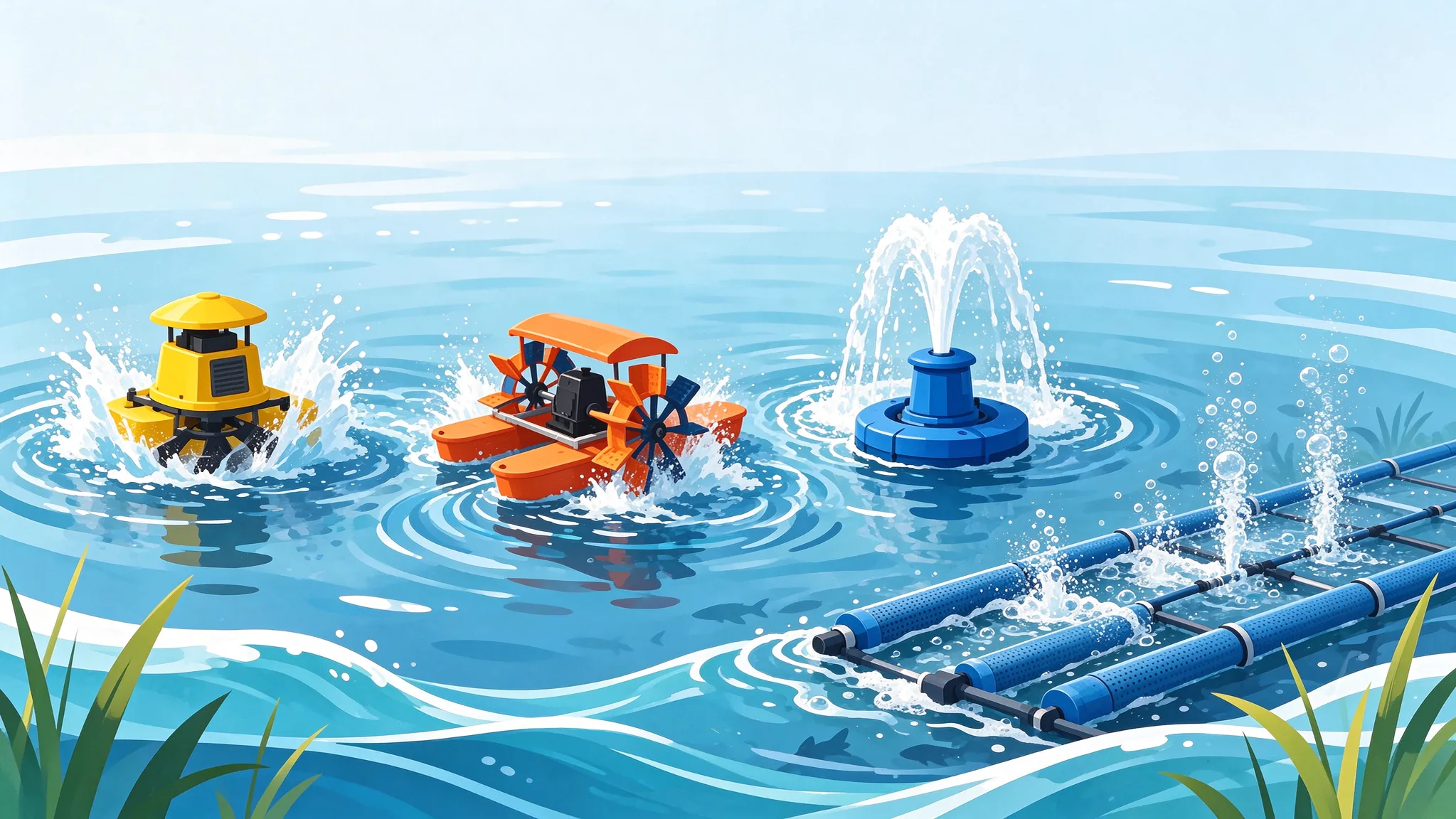
A common mistake: "I installed one aerator, so I'm done." In reality, each machine solves a different problem, and no single type is enough on its own.
① Impeller Aerator — "The All-Rounder"
An electric motor spins an impeller, flinging water into the air and lifting bottom water upward. Highest standard aeration efficiency (≈1.63 kg O₂/kW·h for a 1.5 kW unit), strong mixing and degassing, and the best job at breaking the thermocline. Weaknesses: noisy, single-point coverage — a 1.5 kW unit only reaches about 8–10 m radius (≈2 mu / 0.13 ha). Best for grow-out fish ponds 1.2–2.5 m deep. This is your base unit.
② Paddle-Wheel Aerator — "The Water Mover"
Two side wheels beat the surface like a watermill, creating a directional current. It drives a circular flow across the whole pond, sweeping uneaten feed and feces toward the center drain. Weakness: little vertical mixing, limited bottom oxygen transfer. Best for rectangular high-density shrimp ponds, crab ponds, and any pond with a central drain.
③ Surge / Fountain Aerator — "The Bottom Supporter"
Lifts water from the center and pushes it outward as a broad swell. Low power (typically 0.75 kW), and a strong helper at pushing surface DO down to the edges and bottom. Best for deep ponds (>2.5 m), older ponds with "oxygen debt," and as a complement to an impeller unit.
④ Diffused (Nanotube) Bottom Aeration — "The High-Efficiency Workhorse"
A roots blower pumps air through fine-pore tubes laid on the pond bottom, releasing micro-bubbles that rise from below. Oxygen transfer efficiency is the highest of all (over 30%), quiet, energy-saving, and it directly oxygenates the bottom while suppressing hydrogen sulfide. Downsides: higher installation and maintenance cost, tubes can bio-foul. Best for high-density shrimp, recirculating systems, winter greenhouse ponds, and crab farms.
03How to Combine Them — Pick by Pond Type
The rule of thumb: one unit for a "point," one for a "line," one system for the "bottom."
| Pond Type | Recommended Setup | Reference Capacity |
|---|---|---|
| Standard fish pond 5–10 mu, 1.5–2 m deep | Impeller unit + 1 surge aerator | 0.5–1 kW per mu |
| High-density shrimp pond rectangular, 2–4 mu | 2–4 paddle-wheel units + bottom diffused system | 2 × 1.5 kW paddle wheels + nanotubes |
| Crab / crayfish pond | Bottom diffused aeration + paddle-wheel support | One 1.5 kW paddle wheel per 3–5 mu |
| Deep, aged pond > 2.5 m | Impeller + surge + nanotubes | Focus on bottom oxygen |
| RAS / greenhouse | Roots blower diffused system + emergency impeller | Size blower to stocking density |
04The Running Schedule: "Run Three Times, Don't Run Twice"
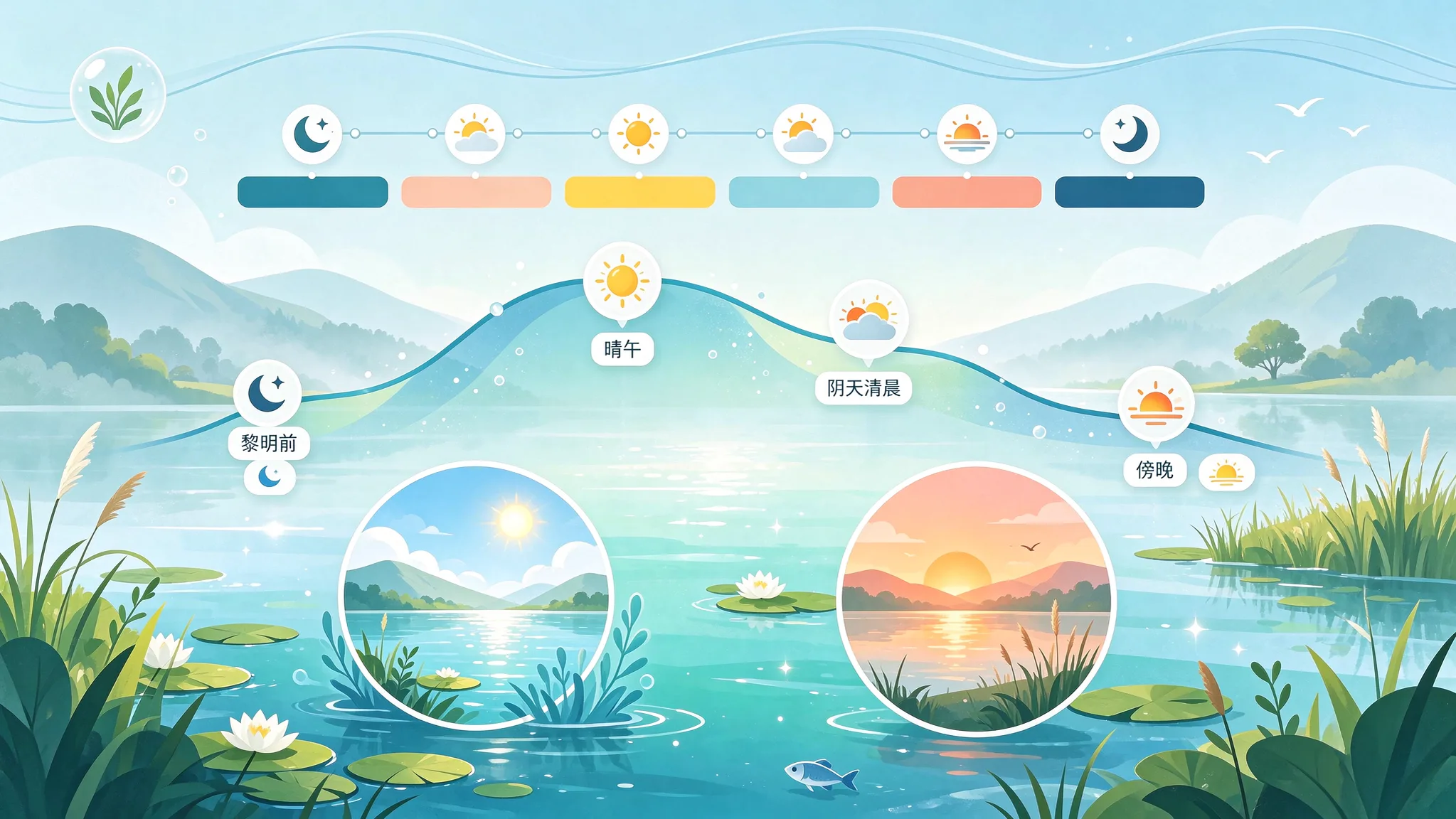
This principle has been promoted by China's national aquaculture extension system for decades and is still written into current MOA guidance. Memorize it and you are 80% there.
✓ Run These Windows
- Sunny midday (11:00–15:00): surface DO is supersaturated. Run 1–2 hours to "bank" oxygen into the bottom layer.
- Cloudy early morning (3–6 a.m.): weak photosynthesis means stored oxygen is low. Start before fish gasp.
- Continuous rain / muggy night: low pressure, no algal production. Start at midnight — do not wait until dawn.
✕ Don't Run These Windows
- Sunny evening: natural mixing happens at dusk; running early only prolongs overnight oxygen drawdown.
- Cloudy midday: surface DO is not supersaturated. Mixing only pulls low-oxygen bottom water up.
Special Weather
- Typhoon / heavy rain: run 24/7 through the event; cut or stop feeding in advance.
- Muggy, windless, foggy days: run from dusk straight through to sunrise.
- Crab ponds in summer: run from 21:00 to 8:00 next day; avoid midday — crabs hide in cool bottom water, and mixing damages the submerged plants.
05Power Outage and Oxygen Emergency — The 3-Piece Backup
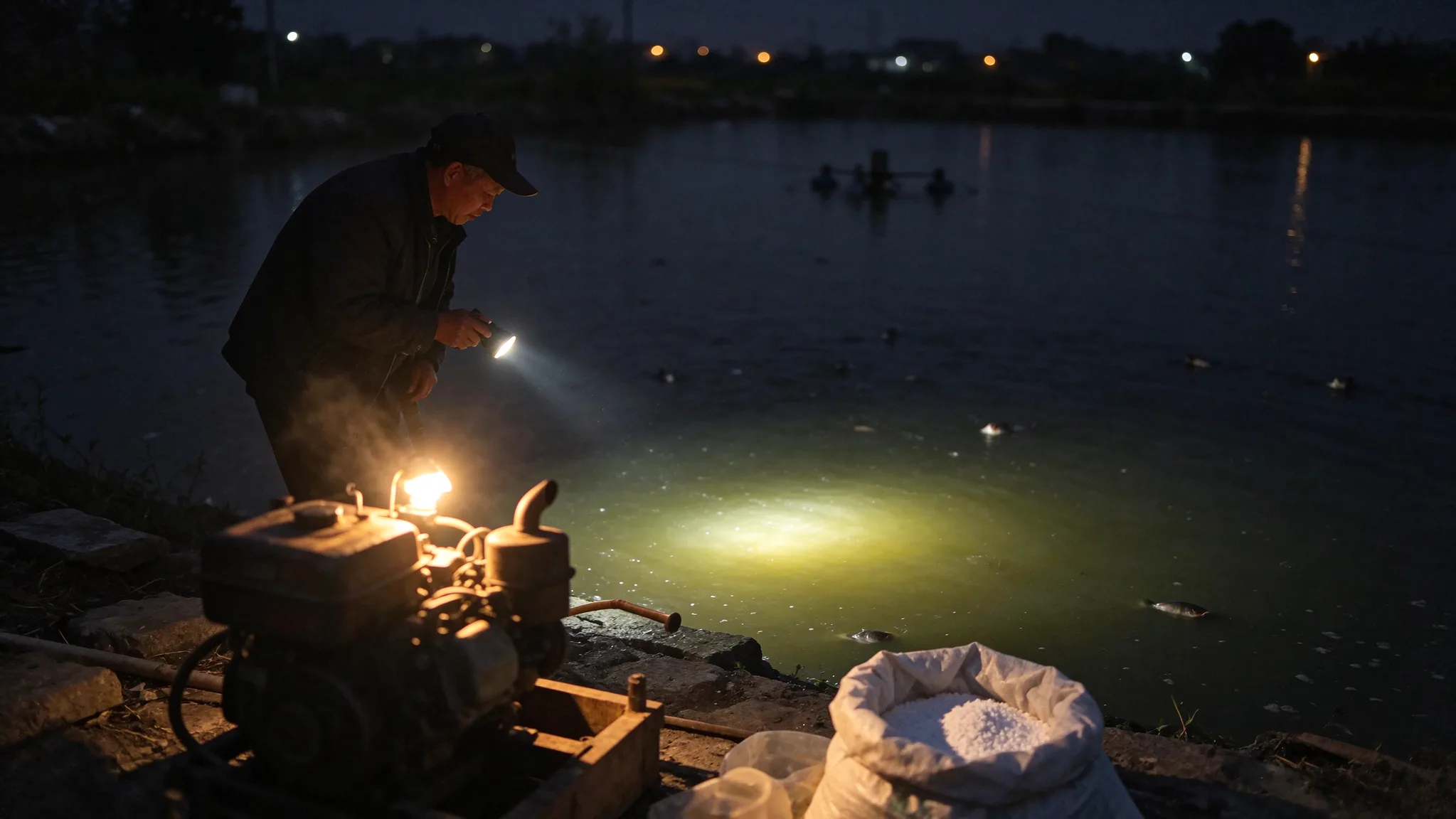
For a fish farmer, a blackout is not an accident — it is a "when," not "if." A 4-hour night outage in a high-density summer pond can cause total crop loss.
① Backup Generator (The Hardware)
- Every commercial farm should own at least one generator sized to start all aerators at once; choose capacity at 1.2× the total motor load.
- Run it unloaded once a month, under load once a quarter; keep the fuel tank at least half full.
- After a blackout, it must be online within 5 minutes — do not wait.
② Chemical Oxygen Source (The "Rescue Drug")
- Common products: sodium percarbonate, calcium peroxide (slow-release oxygen), potassium monopersulfate bottom conditioners.
- Stock: at least 0.5 kg (1 jin) per mu, kept dry and within arm's reach.
- Use: when the generator is not yet online, broadcast evenly across the pond, with extra dose at the downwind side where fish are already surfacing.
- Remember: chemical oxygen only buys 1–2 hours. It is a stopgap, not a substitute for mechanical aeration.
③ Monitoring Tool (Your Eyes)
- A dissolved oxygen meter / DO pen: take at least 3 readings a day — pre-dawn, midday, dusk; add a night reading in hot weather.
- Visual warning: wild fish and shrimp surfacing means DO is already around 2 mg/L; target fish crowding at the surface with mouths open means you are at the danger line.
- Act the moment wild fish surface — do not wait for the target species.
Standard Emergency Flow
- Blackout → start the generator immediately; all aerators back online within 5 minutes.
- If the generator will not start → broadcast chemical oxygen across the pond and open the water inlet.
- If fish are gasping heavily → dose extra chemical oxygen at the most crowded downwind spot; do not leave the pond side.
- If the outage lasts over 2 hours → stop feeding that night; halve or stop feeding the next day.
- When power returns → do not shut aerators off immediately. Run them for another 2–3 hours until DO climbs back above 5 mg/L and fish have fully submerged, then stagger shutdown.
06Five Daily Habits That Matter More Than Equipment
- Keep depth up: 1.8–2.2 m in summer gives fish a cool refuge layer.
- Feed by DO, not by calendar: feed more on sunny days, less on cloudy days, stop on muggy/thunderstorm days. Uneaten feed is the single biggest oxygen sink.
- Condition the bottom every 7–10 days with potassium monopersulfate to pay down "oxygen debt" in the sediment.
- Test water weekly for DO, pH, ammonia and nitrite — twice a week in high season. Online DO monitoring with phone alerts is worth the investment.
- Maintain the equipment: clean impellers, inspect cables, clear bio-fouling from nanotubes every quarter.
07Frequently Asked Questions
Closing
Aeration is not about how many machines you own or how big they are — it is about knowing the water, keeping the schedule, and having a backup plan.
Equipment: impeller for the "point," paddle wheel for the "line," surge for the "layer," nanotube for the "bottom."
Schedule: midday on sunny days, early morning on cloudy days, midnight during rain; off on sunny evenings and cloudy midday.
Backup: generator, chemical oxygen source, and a DO meter — all three, ready at all times.